*/
In February 2015 the Global Law Summit to celebrate 800 years since Magna Carta takes place in London.
Chairman-Elect of the Bar Council Alistair MacDonald QC explains.
To celebrate 800 years since Magna Carta, a worldclass legal event is to be held in London. It will take place at the Queen Elizabeth II Conference Centre and Westminster Central Hall between 23 and 25 February 2015. It is the Global Law Summit, a one-off event organised by a private, not-for-profit organisation whose board includes our former Chairman, Mike Todd QC.
There are a large number of key partners who come from a diverse range of legal institutions and providers. Obviously, the Bar Council will be strongly represented as will organisations such as the Law Society, together with their sister organisations in Scotland and Northern Ireland, as well as the MoJ, the Judiciary and legal groups from the City of London.
The range of international participation is demonstrated by the range of partners from across the globe. The American Bar Association president is speaking at the event and participants include the Korean Bar Association, the Law Council of Australia and the Union Internationale des Avocats. But this will not be an occasion for lawyers alone. Unlike other such conferences, the Global Law Summit will bring together a diverse mixture of legal practitioners, business leaders, representatives of organisations like the British Council and TheCityUK, government ministers and officials, together with politicians from across the political spectrum, to discuss and debate a wide range of issues of contemporary importance.
So what is at the core of this truly international event? It is Magna Carta. The charter has formed the cornerstone of constitutions worldwide and the fundamental principles it enshrines have played a critical part in the establishment of the rule of law in many jurisdictions. Indeed, that continues to be the case, in places in which democratically based legal systems are, even now, being inaugurated.
The purposes of the Summit are very practically based. First, the event will provide a showcase to the world of the unrivalled legal expertise and the unique experience and contributions of UK lawyers, based on a heritage of freedom and individual rights. Second, it will mark the continuing importance of the values expressed in Magna Carta to the maintenance of commercial, political and social fairness, and cohesion. Third, it will also provide an opportunity for UK lawyers to meet and create relationships with key decision-makers from other jurisdictions in order to maintain and enhance the leading role of the UK as the forum of choice for international dispute resolution. Three Specialist Bar Associations (the Chancery Bar Association, the Commercial Bar Association and the Technology and Construction Bar Association) will also be involved in running sessions at the Rolls’ Building and hosting a reception in the Temple.
This will be no anodyne, self-congratulatory conference. Never, in recent times, have the principles of Magna Carta been in more need of resolute defence than now. The Bar Council is organizing three sessions. This first is entitled “Getting the balance right: a comparative approach to judicial review of legislative and executive decisions”, the pithy relevance of which needs no hyperbole from me. The second is “Whose responsibility is it to maintain the Rule of Law?” and the third is “Sanctions and the Rule of Law”. Each of these sessions will give us ample opportunity to make it clear what is special about the services barristers offer and to explain our critical role in the maintenance of the rule of law to delegates, not only from the UK but from every corner of the globe.
These sessions will enable us to address issues of especial relevance in 2015 such as the difficulties of access to justice for those who are disadvantaged in our society. We all know what havoc LASPO has wreaked and the damage it has done to the ability of the poorer members of society to achieve protection and redress.
In addition, the threat of cuts to criminal legal aid was of grave concern to all who valued the maintenance of our unrivalled system of independent expert advocacy services and advice. The curtailment of judicial review was also a very damaging result of legislative change. There is clearly a very important debate to be had about where the boundaries are to be drawn when it comes to the publicly funded provision of financial assistance to litigants in times of global economic difficulty. The Global Law Summit will provide opportunities for us to debate with colleagues from other jurisdictions what is happening in our own justice system and to share our experience. The Bar should be, and will be, at the forefront of such discussions. I mean to ensure that, in our sessions and beyond, our voice will be heard.
To find out more about the Global Law Summit, including details of registration and the early booking rate, go to www.globallawsummit.com.
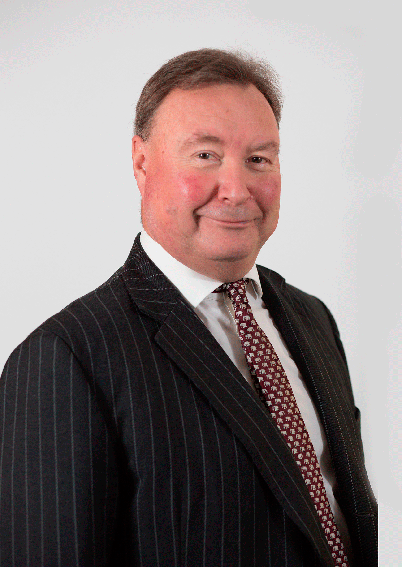
Alistair is Chairman of the Bar Council of England and Wales for 2015. Alistair was called to the Bar in 1983 and took Silk in 2000. Practising from Leeds, he is co-Head of Chambers at New Park Chambers.

Alistair is the Chairman-Elect of the Bar Council. He was Called to the Bar in 1983 and took Silk in 2000. Alistair practises from Leeds and is co-Head of Chambers at New Park Chambers. His pactice is now prncipally in crime although he used to do a broad spread of work including personal injury and administrative law. He is the former Leader of the North-Eastern Circuit and has sat as a Recorder in crime and civil since 1995.
To celebrate 800 years since Magna Carta, a worldclass legal event is to be held in London. It will take place at the Queen Elizabeth II Conference Centre and Westminster Central Hall between 23 and 25 February 2015. It is the Global Law Summit, a one-off event organised by a private, not-for-profit organisation whose board includes our former Chairman, Mike Todd QC.
There are a large number of key partners who come from a diverse range of legal institutions and providers. Obviously, the Bar Council will be strongly represented as will organisations such as the Law Society, together with their sister organisations in Scotland and Northern Ireland, as well as the MoJ, the Judiciary and legal groups from the City of London.
The range of international participation is demonstrated by the range of partners from across the globe. The American Bar Association president is speaking at the event and participants include the Korean Bar Association, the Law Council of Australia and the Union Internationale des Avocats. But this will not be an occasion for lawyers alone. Unlike other such conferences, the Global Law Summit will bring together a diverse mixture of legal practitioners, business leaders, representatives of organisations like the British Council and TheCityUK, government ministers and officials, together with politicians from across the political spectrum, to discuss and debate a wide range of issues of contemporary importance.
So what is at the core of this truly international event? It is Magna Carta. The charter has formed the cornerstone of constitutions worldwide and the fundamental principles it enshrines have played a critical part in the establishment of the rule of law in many jurisdictions. Indeed, that continues to be the case, in places in which democratically based legal systems are, even now, being inaugurated.
The purposes of the Summit are very practically based. First, the event will provide a showcase to the world of the unrivalled legal expertise and the unique experience and contributions of UK lawyers, based on a heritage of freedom and individual rights. Second, it will mark the continuing importance of the values expressed in Magna Carta to the maintenance of commercial, political and social fairness, and cohesion. Third, it will also provide an opportunity for UK lawyers to meet and create relationships with key decision-makers from other jurisdictions in order to maintain and enhance the leading role of the UK as the forum of choice for international dispute resolution. Three Specialist Bar Associations (the Chancery Bar Association, the Commercial Bar Association and the Technology and Construction Bar Association) will also be involved in running sessions at the Rolls’ Building and hosting a reception in the Temple.
This will be no anodyne, self-congratulatory conference. Never, in recent times, have the principles of Magna Carta been in more need of resolute defence than now. The Bar Council is organizing three sessions. This first is entitled “Getting the balance right: a comparative approach to judicial review of legislative and executive decisions”, the pithy relevance of which needs no hyperbole from me. The second is “Whose responsibility is it to maintain the Rule of Law?” and the third is “Sanctions and the Rule of Law”. Each of these sessions will give us ample opportunity to make it clear what is special about the services barristers offer and to explain our critical role in the maintenance of the rule of law to delegates, not only from the UK but from every corner of the globe.
These sessions will enable us to address issues of especial relevance in 2015 such as the difficulties of access to justice for those who are disadvantaged in our society. We all know what havoc LASPO has wreaked and the damage it has done to the ability of the poorer members of society to achieve protection and redress.
In addition, the threat of cuts to criminal legal aid was of grave concern to all who valued the maintenance of our unrivalled system of independent expert advocacy services and advice. The curtailment of judicial review was also a very damaging result of legislative change. There is clearly a very important debate to be had about where the boundaries are to be drawn when it comes to the publicly funded provision of financial assistance to litigants in times of global economic difficulty. The Global Law Summit will provide opportunities for us to debate with colleagues from other jurisdictions what is happening in our own justice system and to share our experience. The Bar should be, and will be, at the forefront of such discussions. I mean to ensure that, in our sessions and beyond, our voice will be heard.
To find out more about the Global Law Summit, including details of registration and the early booking rate, go to www.globallawsummit.com.
In February 2015 the Global Law Summit to celebrate 800 years since Magna Carta takes place in London.
Chairman-Elect of the Bar Council Alistair MacDonald QC explains.

Chair of the Bar finds common ground on legal services between our two jurisdictions, plus an update on jury trials
A £500 donation from AlphaBiolabs has been made to the leading UK charity tackling international parental child abduction and the movement of children across international borders
Marie Law, Director of Toxicology at AlphaBiolabs, outlines the drug and alcohol testing options available for family law professionals, and how a new, free guide can help identify the most appropriate testing method for each specific case
By Louise Crush of Westgate Wealth Management
Marie Law, Director of Toxicology at AlphaBiolabs, examines the latest ONS data on drug misuse and its implications for toxicology testing in family law cases
An interview with Rob Wagg, CEO of New Park Court Chambers
With at least 31 reports of AI hallucinations in UK legal cases – over 800 worldwide – and judges using AI to assist in judicial decision-making, the risks and benefits are impossible to ignore. Matthew Lee examines how different jurisdictions are responding
What has changed, and why? Paul Secher unpacks the new standards aligning the recruiting, training and appraising of judges – the first major change to the system for ten years
The deprivation of liberty is the most significant power the state can exercise. Drawing on frontline experience, Chris Henley KC explains why replacing trial by jury with judge-only trials risks undermining justice
Ever wondered what a pupillage is like at the CPS? This Q and A provides an insight into the training, experience and next steps
The appointments of 96 new King’s Counsel (also known as silk) are announced today