*/
Marie Law, Director of Toxicology at AlphaBiolabs, outlines the drug and alcohol testing options available for family law professionals, and how a new, free guide can help identify the most appropriate testing method for each specific case
Drug and alcohol misuse is a common feature in family court proceedings, with implications for safeguarding, contact, and parenting capacity. Laboratory testing provides vital evidence, but only when the right test is selected.
Different testing methods detect different substances over varying timeframes. A test that’s too specific, too broad, or poorly matched to the case may miss key information or lead to misinterpretation. For legal professionals, understanding which testing method to instruct in a given context is key to building a robust evidential picture and supporting safe, timely decisions in the best interests of children or other vulnerable people.
AlphaBiolabs offers the UK’s most comprehensive portfolio of drug and alcohol testing services for family law professionals.
Our laboratory can test sample types including hair, nails, oral fluid, urine, blood, and breath. We also offer SCRAM Continuous Alcohol Monitoring® (SCRAM CAM®).
Each testing method differs by:
Choosing the right test depends on the substances involved, the sample types available, and the evidence required by the court.
Drug and alcohol tests fall broadly into two categories: narrow-window and wide-window testing, based on how far back substance use can be detected.
Narrow-window tests detect recent or very recent use, from a few hours to several days, and are ideal for point-of-care/pre-contact checks, unannounced testing, or short-term compliance.
Wide-window tests detect longer-term patterns of use, and are useful for assessing abstinence, long-term behaviour, or chronic misuse.
Choosing between narrow-window and wide-window methods depends on what the court needs to establish. In many cases, a combination of test types offers the most in-depth picture.
Selecting the right test involves more than just timeframe. Other key factors include the reason for the test, sample availability, court requirements, and whether repeat testing is needed.
Matching the method to the case ensures results are relevant, reliable, and court admissible.
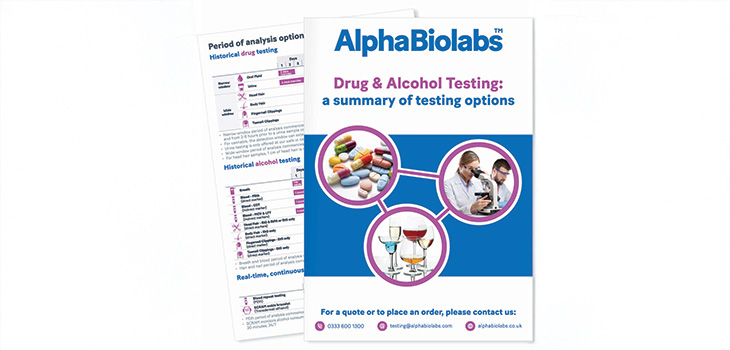
At AlphaBiolabs, we recognise that the wide range of testing options available can be confusing, and that selecting the most appropriate test for a particular scenario is not always straightforward. We have therefore developed a new, free reference guide specifically for family law professionals: Drug & Alcohol Testing: a summary of testing options.
This user-friendly and highly practical resource includes:

Marie Law is Director of Toxicology at AlphaBiolabs. A highly-skilled and respected scientist with over 15 years’ experience in the field of forensics, Marie joined AlphaBiolabs in 2022 and oversees the company’s growing toxicology team. As Director of Toxicology, Marie’s day-to-day responsibilities include maintaining the highest quality testing standards for toxicology and further enhancing AlphaBiolabs’ drug and alcohol testing services for the legal sector, members of the public, and the workplace sector.
Drug and alcohol misuse is a common feature in family court proceedings, with implications for safeguarding, contact, and parenting capacity. Laboratory testing provides vital evidence, but only when the right test is selected.
Different testing methods detect different substances over varying timeframes. A test that’s too specific, too broad, or poorly matched to the case may miss key information or lead to misinterpretation. For legal professionals, understanding which testing method to instruct in a given context is key to building a robust evidential picture and supporting safe, timely decisions in the best interests of children or other vulnerable people.
AlphaBiolabs offers the UK’s most comprehensive portfolio of drug and alcohol testing services for family law professionals.
Our laboratory can test sample types including hair, nails, oral fluid, urine, blood, and breath. We also offer SCRAM Continuous Alcohol Monitoring® (SCRAM CAM®).
Each testing method differs by:
Choosing the right test depends on the substances involved, the sample types available, and the evidence required by the court.
Drug and alcohol tests fall broadly into two categories: narrow-window and wide-window testing, based on how far back substance use can be detected.
Narrow-window tests detect recent or very recent use, from a few hours to several days, and are ideal for point-of-care/pre-contact checks, unannounced testing, or short-term compliance.
Wide-window tests detect longer-term patterns of use, and are useful for assessing abstinence, long-term behaviour, or chronic misuse.
Choosing between narrow-window and wide-window methods depends on what the court needs to establish. In many cases, a combination of test types offers the most in-depth picture.
Selecting the right test involves more than just timeframe. Other key factors include the reason for the test, sample availability, court requirements, and whether repeat testing is needed.
Matching the method to the case ensures results are relevant, reliable, and court admissible.
At AlphaBiolabs, we recognise that the wide range of testing options available can be confusing, and that selecting the most appropriate test for a particular scenario is not always straightforward. We have therefore developed a new, free reference guide specifically for family law professionals: Drug & Alcohol Testing: a summary of testing options.
This user-friendly and highly practical resource includes:
Marie Law, Director of Toxicology at AlphaBiolabs, outlines the drug and alcohol testing options available for family law professionals, and how a new, free guide can help identify the most appropriate testing method for each specific case


Chair of the Bar finds common ground on legal services between our two jurisdictions, plus an update on jury trials
A £500 donation from AlphaBiolabs has been made to the leading UK charity tackling international parental child abduction and the movement of children across international borders
Marie Law, Director of Toxicology at AlphaBiolabs, outlines the drug and alcohol testing options available for family law professionals, and how a new, free guide can help identify the most appropriate testing method for each specific case
By Louise Crush of Westgate Wealth Management
Marie Law, Director of Toxicology at AlphaBiolabs, examines the latest ONS data on drug misuse and its implications for toxicology testing in family law cases
An interview with Rob Wagg, CEO of New Park Court Chambers
The deprivation of liberty is the most significant power the state can exercise. Drawing on frontline experience, Chris Henley KC explains why replacing trial by jury with judge-only trials risks undermining justice
Ever wondered what a pupillage is like at the CPS? This Q and A provides an insight into the training, experience and next steps
The appointments of 96 new King’s Counsel (also known as silk) are announced today
Resolution of the criminal justice crisis does not lie in reheating old ideas that have been roundly rejected before, say Ed Vickers KC, Faras Baloch and Katie Bacon
With pupillage application season under way, Laura Wright reflects on her route to ‘tech barrister’ and offers advice for those aiming at a career at the Bar