*/
The odds of success are as unforgiving as ever, but ambition clearly isn’t in short supply. David Wurtzel’s annual deep‑dive into the competition cohort shows who’s entering, who’s thriving and the trends that will define the next wave
On 29 April 2003 the then Lord Chancellor, Lord Irvine of Lairg, told the new QCs in Westminster Hall that they were likely to be the last cohort. The Office of Fair Trading had already queried whether it was in the interest of consumers that the government should make it possible for the top 10% of the Bar to charge enhanced fees. By 16 June, the new Lord Chancellor, Lord Falconer of Thoroton, told the House of Lords that the government would consult as to whether it was appropriate ‘that the state should give a kite mark from which people [i.e., QCs] benefit substantially’. The Bar insisted that a kite mark was precisely in the public interest. And doubtless deserved the substantial benefit.
The state duly divested itself of the task of deciding who deserved to receive the kite mark but the kite mark survived. As did the office of Lord Chancellor (also under threat in 2003) who still approves the list and grants the kite mark in the traditional Westminster Hall ceremony. King’s Counsel Appointments (KCA) was created to deal with the entire process of selection. The extra benefit from receiving the kite mark has ceased to be an issue.
The KC Selection Panel, as is now standard, is made up of lay, judicial (retired) and legal members who are admirably transparent in how they go about their task. The criteria for selection, which is agreed between the Bar Council and the Law Society, fulfils the Bar’s argument that the kite mark is needed to single out excellence: excellence in advocacy in the higher courts as demonstrated by 12 cases in the previous three years of ‘substance, complexity or particular difficult or sensitivity’.* The panel takes the applicants (and the Bar) as it finds them. There are no quotas. Applicants are asked to identify their gender, ethnicity, sexual preference, etc., but these are not disclosed to panel members during the selection process. The decision-making rests on what is in the application, in what is said about the applicant by professional and lay clients and judges whom the applicant has put forward to approach as assessors and – if they get that far – an interview.
It is statistically challenging to succeed, but there is no shortage of those willing to try. This year (2025) there were 325 applicants, almost the same as 2024’s 326 which was the highest number since 2007-08. There are 96 appointments, down from 105 in 2024. The overall success rate thus declined, to 29.5%, the lowest since KCA started in 2006 apart from 29.4% in 2007-08. It has been steadily declining since 2018 and was 32% in 2024. There is a cut-off point in the process when the panel, after full discussion, weeds out those it feels have no reasonable chance of success. The number who are then invited for interview has likewise declined, from 63% in 2020. This year 51% of women and 43% of men were interviewed. The final success rate for women was 34% (29 applicants) v 28% (67 applicants) for men. It follows that in raw numbers, there are fewer men and women who are recommended for appointment than there were in the previous competition or several years before that.
In percentage terms women have been more successful than men in 18 out of the last 20 competitions. Most importantly, the number of women applicants goes up every year. It was 86 this time, a record. The 29 successful women are distributed between civil work (17 out of 66 or 26%), criminal work (11 out of 24 or 45%) and family (1 out of 6).
Each cohort produces different figures but some factors are constant, year on year. Having gone through the chambers’ website entry of each of the 96 who are recommended for appointment, it is obvious that applying for King’s Counsel is something which is only relevant to a small part of the Bar. There are some 400 sets of chambers with more than one practising barrister in them. No more than a quarter of sets ever produce silks. The average number of chambers per year is 65, as it was in 2025. Four sets produced the six family silks; all are London based. Twenty-one sets produced the 24 criminal silks; 13 are London based. Thirty-nine sets produced the 66 civil silks; 37 are London based. Five London-based chambers produced 17 silks between them; 19 further sets produced two each. The non-London sets were in Bristol, Manchester, Leeds, Birmingham, Chester and Exeter. Every new silk is in chambers that already has silks, a fact which repeats itself every year with no more than the occasional exception of one or two first timers for their chambers. On average, the criminal sets had 13 silks each, the family sets 12 and the civil sets 27.
It is difficult to avoid the conclusion that the distribution of junior briefs of higher court cases of ‘substance, complexity, or particularly difficulty or sensitivity’ – what one could call ‘pre-silk work’ – is not evenly distributed throughout the Bar but is going to be found in the chambers that are already rich in silks. It is something that aspiring young barristers in chambers which have never had a silk need to note.
KCA does not ask about university, being concerned with present achievements rather than the past. But it is clearly relevant to the Bar. Every year two thirds of the new cohort are civil law practitioners, the majority of whom list their education on their chambers’ webpage. Nineteen this year declare that they went to Oxford, including 6 firsts and 2 highest firsts in their year; 24 went to Cambridge, half of whom had a first, a double first or a double starred first. Others went to Russell Group universities including firsts at King’s College London and at Bristol. This does not tell us why they got silk, but it may tell us how they got pupillage in the silk-rich chambers. Fewer criminal practitioners list their education: nine went to Russell Group universities and four to Oxford or Cambridge. The small family law cohort is evenly distributed between Manchester, Cambridge and Queen Mary London.
One of the striking characteristics of every cohort is age, which may say something about how long it takes barristers who specialise in different areas to build up their practices to the point where they decide that it is time to apply for silk. The date of call of course is not in itself evidence of chronological age: the most recent new silk was called in 2014 but had spent some years practising as a solicitor before switching to the Bar. Nevertheless, the most successful group of applicants is always the youngest. This year, 44% of new silks are aged 35-44 while only 5% are aged over 55. The former’s success rate in applications was 40%, having been 46% last year. Turning to specialisms, half of new civil KCs were called from 2006 onwards while only 25% of criminal barristers were. Of the family cohort, two were called in 2006 and two (and in the same chambers) in 2008.
There has been no criticism of the selection by the panel in terms of applying the criteria which, as above, have been agreed between Bar Council and the Law Society; no suggestion that the cohorts which have been put forward for appointment are not made up of advocates who have demonstrated excellence. The criticism has been about King’s Counsel themselves, the attributes which the panel does not and cannot take into consideration when assessing excellence.
First, there is the issue of applicants who are not self-employed barristers. Although the system has been set up to allow solicitor advocates and employed barristers to be assessed fairly along with the other applicants, these two categories have extremely low success rates. The average number of solicitor advocates who apply over the last 18 years is slightly fewer than eight. The average number who are appointed is three. This year there were nine applicants, none of whom were interviewed. The panel’s annual report thus states, as it does every year, that there seems to be hesitancy among some solicitors to apply and so they are working with the Law Society to see how ‘we can support them in encouraging more applications’. We await year after year to be told what the way forward is.
As for employed barristers, the average number of applicants is fewer than five (this year it was 11) out of around 3,000 employed barristers. The average success rate is one per year. This year there are two: one is a barrister employed by Norton Rose Fulbright, specialising in commercial disputes. It is difficult not to conclude that a higher court practice necessary for applicants to put forward their 12 relevant cases, is not what many employed barristers do.
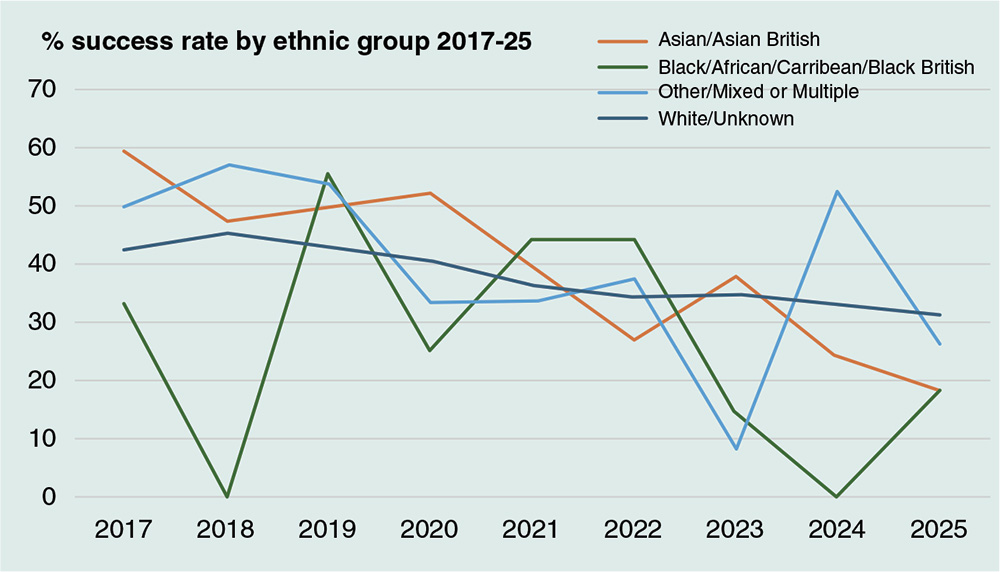
In terms of diversity, KCA publishes a monitoring table, based on the answers given by applicants. Not everyone answers every question. From 2017, KCA has published a breakdown of ethnic minority data by Asian or Asian British; Black, African, Caribbean or Black British; and Other. From 2024 KCA introduced another category: Mixed or Multiple Ethnic Groups. For several years since 2017, there was a total application number from all these groups of 38, but it was 48 in 2023, 60 last year and 52 this year.
The average number of Asian/Asian British applicants is 23.6 per year with 9.1 or 38.6% successful. There were fewer this year – four (18.2%) – two men (one in family work, one in civil work) and two women (one in commercial work, one in criminal work) from an Asian background.
The average number of Black, African, Caribbean or Black British applicants is 7.3 per year, with two annual appointments or 27.4%. No Black silks were successful in the 2024 competition but this year two male barristers from a Black ethnic group were appointed, one in civil work and one in family work (18.2%).
On average there have been 10.8 applications per year from Mixed, Multiple or Other Ethnic Groups with 4.2 successful or 39%; 5 were appointed this year (26.3%).
Taking all 52 applicants in this competition who declared an ethnic background other than White (around 16% of total applicants), 19 were interviewed (37% v 45% for White applicants) and 11 were appointed, which is 21% (down from 30% last year) of ethnic minority applicants v 31% for White applicants (down from 33% last year).
The number of applicants who declare that they are gay, lesbian or bisexual tends to be relatively small, although this is the question that fewest answer. This year only a quarter of gay men and no lesbians were appointed.
The number of applicants who declared that they had a disability was 19 last year (8 appointed, or 42%) and 18 this year (4 appointed, or 22%).
As late as 2017 KCA was stating that it published profiles of new QCs to demonstrate that, unlike the past, QCs were not ‘effectively confined’ to ‘white male barristers educated at public schools and Oxbridge’. Since KCA doesn’t ask for applicants’ education it of course wouldn’t know. A trawl through chambers’ websites shows that half the men and women recommended for appointment in the 2025 competition across ethnic groups still go to Oxbridge. That includes a woman with a double starred first from Cambridge and a woman with the highest first in her year at Oxford. Only one of the 96 lists their school (Ampleforth). But the question of social class presumably still persists.
Applicants may ask to pay a reduced application fee if their income is less than £90,000 per year. Seven did. Which puts 318 in the top (at least) 4% of UK earners.
KCA asked about eligibility for free school meals as a child. Across the 2024 and 2025 competitions, 13% said that they were. They had a 25% success rate, though a greater number replied that they did not know or preferred not to say.
Finally, failure is not always forever. Repeat applications are no bar, although every year a number who were interviewed in the past were not interviewed this time. In 2025, half the cohort were first-time applicants, and half were trying again.
* KCA guidance says that where there is a good reason, such as the COVID pandemic, a career break or a disability, it is acceptable to list cases from before the previous three years, or to list fewer than 12.
Fees payable
The fees were increased in 2025. The application fee rose from £2,100 to £2,225, and for applicants who are appointed, the appointment fee increased from £3,600 to £3,900. There is also the cost of Letters Patent. VAT is payable on the application and appointment fees. Seven applicants asked to pay a reduced application fee which they can do if their income is less than £90,000 per year.
Nearly 3,000 assessments
1,985 assessors provided a total of 2,913 assessments to the Selection Panel in the 2025 competition; 277 assessors did not provide assessments sought: 205 said they were unable to provide assessments on at least one applicant; 72 were unavailable or failed to respond to the request in relation to one or more assessments.
Bar chief congratulates the 96 – more work to be done on diversity
Chair of the Bar Kirsty Brimelow KC sent her warmest congratulations to all those successful in their silk application and her commiserations to those who were unsuccessful this year.
‘I wasn’t successful on my first occasion of application. I do hope you will try again in future,’ she said. ‘It is positive there are successful applicants from diverse backgrounds,’ Kirsty added. ‘However, any differences in success rates relating to protected characteristics are of concern to the Bar Council, Law Society and King’s Counsel Appointments. Keeping in focus the poorer outcomes for those from minority groups over other years, there remains more work to do. We’ll continue to investigate where there are barriers to appointment, including at the employed Bar, and we’re keen to support further improvements to the processes for applying...’


David Wurtzel practised at the criminal Bar for 27 years and is a door tenant at 18 Red Lion Court. Prior to his retirement, he was a consultant in the CPD department at City Law School and consultant editor of Counsel. David is a member of the Counsel Editorial Board.
On 29 April 2003 the then Lord Chancellor, Lord Irvine of Lairg, told the new QCs in Westminster Hall that they were likely to be the last cohort. The Office of Fair Trading had already queried whether it was in the interest of consumers that the government should make it possible for the top 10% of the Bar to charge enhanced fees. By 16 June, the new Lord Chancellor, Lord Falconer of Thoroton, told the House of Lords that the government would consult as to whether it was appropriate ‘that the state should give a kite mark from which people [i.e., QCs] benefit substantially’. The Bar insisted that a kite mark was precisely in the public interest. And doubtless deserved the substantial benefit.
The state duly divested itself of the task of deciding who deserved to receive the kite mark but the kite mark survived. As did the office of Lord Chancellor (also under threat in 2003) who still approves the list and grants the kite mark in the traditional Westminster Hall ceremony. King’s Counsel Appointments (KCA) was created to deal with the entire process of selection. The extra benefit from receiving the kite mark has ceased to be an issue.
The KC Selection Panel, as is now standard, is made up of lay, judicial (retired) and legal members who are admirably transparent in how they go about their task. The criteria for selection, which is agreed between the Bar Council and the Law Society, fulfils the Bar’s argument that the kite mark is needed to single out excellence: excellence in advocacy in the higher courts as demonstrated by 12 cases in the previous three years of ‘substance, complexity or particular difficult or sensitivity’.* The panel takes the applicants (and the Bar) as it finds them. There are no quotas. Applicants are asked to identify their gender, ethnicity, sexual preference, etc., but these are not disclosed to panel members during the selection process. The decision-making rests on what is in the application, in what is said about the applicant by professional and lay clients and judges whom the applicant has put forward to approach as assessors and – if they get that far – an interview.
It is statistically challenging to succeed, but there is no shortage of those willing to try. This year (2025) there were 325 applicants, almost the same as 2024’s 326 which was the highest number since 2007-08. There are 96 appointments, down from 105 in 2024. The overall success rate thus declined, to 29.5%, the lowest since KCA started in 2006 apart from 29.4% in 2007-08. It has been steadily declining since 2018 and was 32% in 2024. There is a cut-off point in the process when the panel, after full discussion, weeds out those it feels have no reasonable chance of success. The number who are then invited for interview has likewise declined, from 63% in 2020. This year 51% of women and 43% of men were interviewed. The final success rate for women was 34% (29 applicants) v 28% (67 applicants) for men. It follows that in raw numbers, there are fewer men and women who are recommended for appointment than there were in the previous competition or several years before that.
In percentage terms women have been more successful than men in 18 out of the last 20 competitions. Most importantly, the number of women applicants goes up every year. It was 86 this time, a record. The 29 successful women are distributed between civil work (17 out of 66 or 26%), criminal work (11 out of 24 or 45%) and family (1 out of 6).
Each cohort produces different figures but some factors are constant, year on year. Having gone through the chambers’ website entry of each of the 96 who are recommended for appointment, it is obvious that applying for King’s Counsel is something which is only relevant to a small part of the Bar. There are some 400 sets of chambers with more than one practising barrister in them. No more than a quarter of sets ever produce silks. The average number of chambers per year is 65, as it was in 2025. Four sets produced the six family silks; all are London based. Twenty-one sets produced the 24 criminal silks; 13 are London based. Thirty-nine sets produced the 66 civil silks; 37 are London based. Five London-based chambers produced 17 silks between them; 19 further sets produced two each. The non-London sets were in Bristol, Manchester, Leeds, Birmingham, Chester and Exeter. Every new silk is in chambers that already has silks, a fact which repeats itself every year with no more than the occasional exception of one or two first timers for their chambers. On average, the criminal sets had 13 silks each, the family sets 12 and the civil sets 27.
It is difficult to avoid the conclusion that the distribution of junior briefs of higher court cases of ‘substance, complexity, or particularly difficulty or sensitivity’ – what one could call ‘pre-silk work’ – is not evenly distributed throughout the Bar but is going to be found in the chambers that are already rich in silks. It is something that aspiring young barristers in chambers which have never had a silk need to note.
KCA does not ask about university, being concerned with present achievements rather than the past. But it is clearly relevant to the Bar. Every year two thirds of the new cohort are civil law practitioners, the majority of whom list their education on their chambers’ webpage. Nineteen this year declare that they went to Oxford, including 6 firsts and 2 highest firsts in their year; 24 went to Cambridge, half of whom had a first, a double first or a double starred first. Others went to Russell Group universities including firsts at King’s College London and at Bristol. This does not tell us why they got silk, but it may tell us how they got pupillage in the silk-rich chambers. Fewer criminal practitioners list their education: nine went to Russell Group universities and four to Oxford or Cambridge. The small family law cohort is evenly distributed between Manchester, Cambridge and Queen Mary London.
One of the striking characteristics of every cohort is age, which may say something about how long it takes barristers who specialise in different areas to build up their practices to the point where they decide that it is time to apply for silk. The date of call of course is not in itself evidence of chronological age: the most recent new silk was called in 2014 but had spent some years practising as a solicitor before switching to the Bar. Nevertheless, the most successful group of applicants is always the youngest. This year, 44% of new silks are aged 35-44 while only 5% are aged over 55. The former’s success rate in applications was 40%, having been 46% last year. Turning to specialisms, half of new civil KCs were called from 2006 onwards while only 25% of criminal barristers were. Of the family cohort, two were called in 2006 and two (and in the same chambers) in 2008.
There has been no criticism of the selection by the panel in terms of applying the criteria which, as above, have been agreed between Bar Council and the Law Society; no suggestion that the cohorts which have been put forward for appointment are not made up of advocates who have demonstrated excellence. The criticism has been about King’s Counsel themselves, the attributes which the panel does not and cannot take into consideration when assessing excellence.
First, there is the issue of applicants who are not self-employed barristers. Although the system has been set up to allow solicitor advocates and employed barristers to be assessed fairly along with the other applicants, these two categories have extremely low success rates. The average number of solicitor advocates who apply over the last 18 years is slightly fewer than eight. The average number who are appointed is three. This year there were nine applicants, none of whom were interviewed. The panel’s annual report thus states, as it does every year, that there seems to be hesitancy among some solicitors to apply and so they are working with the Law Society to see how ‘we can support them in encouraging more applications’. We await year after year to be told what the way forward is.
As for employed barristers, the average number of applicants is fewer than five (this year it was 11) out of around 3,000 employed barristers. The average success rate is one per year. This year there are two: one is a barrister employed by Norton Rose Fulbright, specialising in commercial disputes. It is difficult not to conclude that a higher court practice necessary for applicants to put forward their 12 relevant cases, is not what many employed barristers do.
In terms of diversity, KCA publishes a monitoring table, based on the answers given by applicants. Not everyone answers every question. From 2017, KCA has published a breakdown of ethnic minority data by Asian or Asian British; Black, African, Caribbean or Black British; and Other. From 2024 KCA introduced another category: Mixed or Multiple Ethnic Groups. For several years since 2017, there was a total application number from all these groups of 38, but it was 48 in 2023, 60 last year and 52 this year.
The average number of Asian/Asian British applicants is 23.6 per year with 9.1 or 38.6% successful. There were fewer this year – four (18.2%) – two men (one in family work, one in civil work) and two women (one in commercial work, one in criminal work) from an Asian background.
The average number of Black, African, Caribbean or Black British applicants is 7.3 per year, with two annual appointments or 27.4%. No Black silks were successful in the 2024 competition but this year two male barristers from a Black ethnic group were appointed, one in civil work and one in family work (18.2%).
On average there have been 10.8 applications per year from Mixed, Multiple or Other Ethnic Groups with 4.2 successful or 39%; 5 were appointed this year (26.3%).
Taking all 52 applicants in this competition who declared an ethnic background other than White (around 16% of total applicants), 19 were interviewed (37% v 45% for White applicants) and 11 were appointed, which is 21% (down from 30% last year) of ethnic minority applicants v 31% for White applicants (down from 33% last year).
The number of applicants who declare that they are gay, lesbian or bisexual tends to be relatively small, although this is the question that fewest answer. This year only a quarter of gay men and no lesbians were appointed.
The number of applicants who declared that they had a disability was 19 last year (8 appointed, or 42%) and 18 this year (4 appointed, or 22%).
As late as 2017 KCA was stating that it published profiles of new QCs to demonstrate that, unlike the past, QCs were not ‘effectively confined’ to ‘white male barristers educated at public schools and Oxbridge’. Since KCA doesn’t ask for applicants’ education it of course wouldn’t know. A trawl through chambers’ websites shows that half the men and women recommended for appointment in the 2025 competition across ethnic groups still go to Oxbridge. That includes a woman with a double starred first from Cambridge and a woman with the highest first in her year at Oxford. Only one of the 96 lists their school (Ampleforth). But the question of social class presumably still persists.
Applicants may ask to pay a reduced application fee if their income is less than £90,000 per year. Seven did. Which puts 318 in the top (at least) 4% of UK earners.
KCA asked about eligibility for free school meals as a child. Across the 2024 and 2025 competitions, 13% said that they were. They had a 25% success rate, though a greater number replied that they did not know or preferred not to say.
Finally, failure is not always forever. Repeat applications are no bar, although every year a number who were interviewed in the past were not interviewed this time. In 2025, half the cohort were first-time applicants, and half were trying again.
* KCA guidance says that where there is a good reason, such as the COVID pandemic, a career break or a disability, it is acceptable to list cases from before the previous three years, or to list fewer than 12.
Fees payable
The fees were increased in 2025. The application fee rose from £2,100 to £2,225, and for applicants who are appointed, the appointment fee increased from £3,600 to £3,900. There is also the cost of Letters Patent. VAT is payable on the application and appointment fees. Seven applicants asked to pay a reduced application fee which they can do if their income is less than £90,000 per year.
Nearly 3,000 assessments
1,985 assessors provided a total of 2,913 assessments to the Selection Panel in the 2025 competition; 277 assessors did not provide assessments sought: 205 said they were unable to provide assessments on at least one applicant; 72 were unavailable or failed to respond to the request in relation to one or more assessments.
Bar chief congratulates the 96 – more work to be done on diversity
Chair of the Bar Kirsty Brimelow KC sent her warmest congratulations to all those successful in their silk application and her commiserations to those who were unsuccessful this year.
‘I wasn’t successful on my first occasion of application. I do hope you will try again in future,’ she said. ‘It is positive there are successful applicants from diverse backgrounds,’ Kirsty added. ‘However, any differences in success rates relating to protected characteristics are of concern to the Bar Council, Law Society and King’s Counsel Appointments. Keeping in focus the poorer outcomes for those from minority groups over other years, there remains more work to do. We’ll continue to investigate where there are barriers to appointment, including at the employed Bar, and we’re keen to support further improvements to the processes for applying...’
The odds of success are as unforgiving as ever, but ambition clearly isn’t in short supply. David Wurtzel’s annual deep‑dive into the competition cohort shows who’s entering, who’s thriving and the trends that will define the next wave


Chair of the Bar finds common ground on legal services between our two jurisdictions, plus an update on jury trials
A £500 donation from AlphaBiolabs has been made to the leading UK charity tackling international parental child abduction and the movement of children across international borders
Marie Law, Director of Toxicology at AlphaBiolabs, outlines the drug and alcohol testing options available for family law professionals, and how a new, free guide can help identify the most appropriate testing method for each specific case
By Louise Crush of Westgate Wealth Management
Marie Law, Director of Toxicology at AlphaBiolabs, examines the latest ONS data on drug misuse and its implications for toxicology testing in family law cases
An interview with Rob Wagg, CEO of New Park Court Chambers
The deprivation of liberty is the most significant power the state can exercise. Drawing on frontline experience, Chris Henley KC explains why replacing trial by jury with judge-only trials risks undermining justice
Ever wondered what a pupillage is like at the CPS? This Q and A provides an insight into the training, experience and next steps
The appointments of 96 new King’s Counsel (also known as silk) are announced today
Resolution of the criminal justice crisis does not lie in reheating old ideas that have been roundly rejected before, say Ed Vickers KC, Faras Baloch and Katie Bacon
With pupillage application season under way, Laura Wright reflects on her route to ‘tech barrister’ and offers advice for those aiming at a career at the Bar