*/
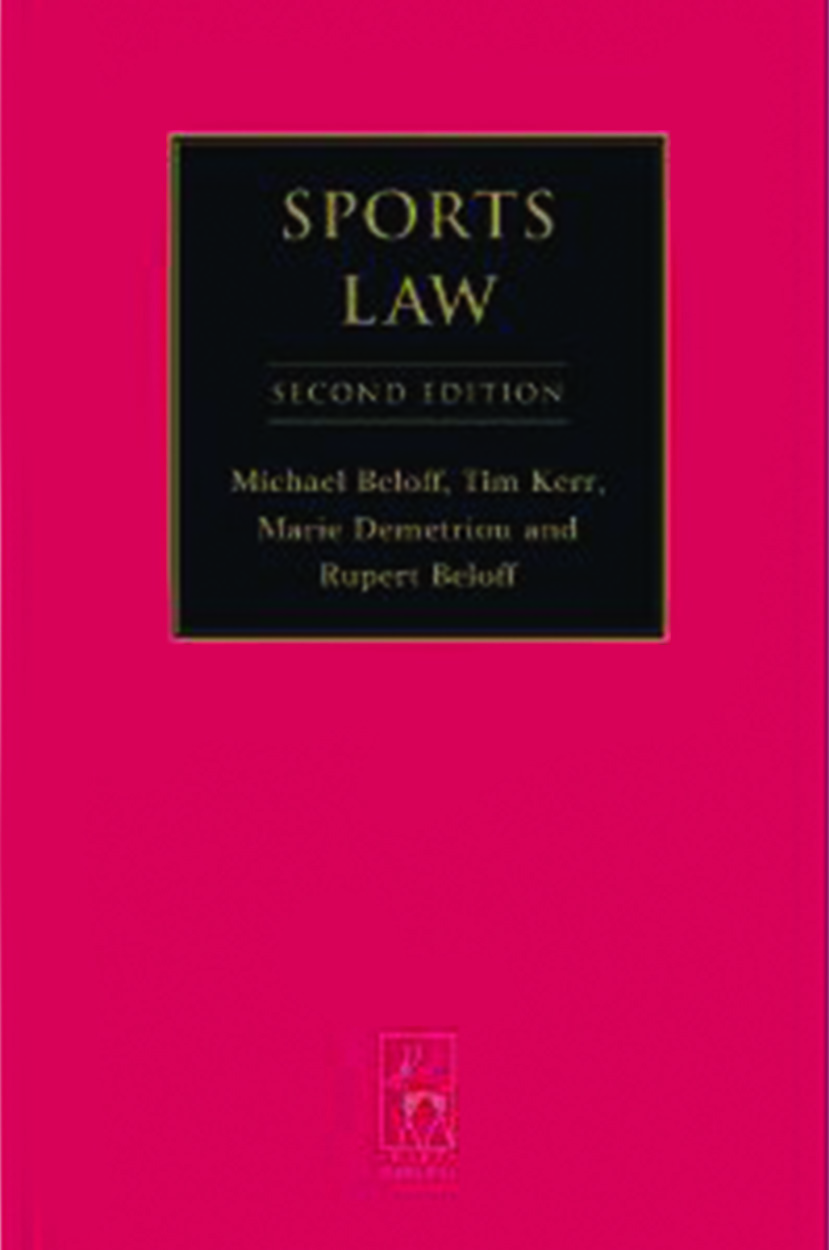 Sports Law (Second Edition)
by Michael Beloff, Tim Kerr, Marie Demetriou and Rupert Beloff
Published by Hart Publishing, October 2012
ISBN 1841133671
£95
Any lawyer interested in the field of sports law should have the Second Edition of “Sports Law ” to hand; its lucid, comprehensive yet concise exposition of the relevant jurisprudence is as invigorating as a cold blast of fresh air in a sweaty workout. It reads like a good opinion, in which the author has mastered his subject and speaks authoritatively, with the answer and reasoning set out clearly and succinctly.
The study is coherent: first, the pre-competition stage; second, the competition itself; third, the aftermath of disputes and disciplinary measures.
The pre-competition stage focuses on the institutions that govern sport, their relations with each other and those taking part, and how the rules that control participation are established. The international and European aspects of sports law are particularly expertly covered: players’ rights and transfers as well as the commercial exploitation of sport where Articles 101 and 102 of the TFEU are to the fore. A section is devoted to the protection of children in sport.
When the match kicks off, we are into the regulation of the action on the pitch and the potential liabilities, tortious and criminal. The burgeoning area of disciplinary proceedings is thoroughly set out, particularly regarding anti-doping. The practical management of disciplinary issues provides particular insight.
After the final whistle, the narrative turns to the mechanisms for the resolution of legal disputes in sport. A cogent case is made for why English law took a wrong turn when it decided that judicial review would rarely if ever be available to challenge the decision of a sporting body (per the Court of Appeal in ex parte Aga Khan).
Sports Law is written with intellectual rigour combined with a zest for the subject matter. The four authors bring a diversity of juridical backgrounds that instils a breadth of vision into the analysis. If you are a busy practitioner looking for the “answer” to a sports law problem, this is the textbook; if you are an academic searching for some underlying principles and theories, there is plenty for you too.
In the interests of BBC balance, I looked forlornly for some reason to criticise the book and had all but given up the search when I spotted the following in the Table of Abbreviations: “MCC - Middlesex Cricket Club”. As a playing member of the Marylebone Cricket Club, I’ve got to refer that one to Hawkeye.
Tim Lord QC has a wide commercial practice at Brick Court Chambers, which includes sports related disputes. He played first class rugby and cricket whilst at Cambridge University reading law and is now a playing member of the MCC.
When the match kicks off, we are into the regulation of the action on the pitch and the potential liabilities, tortious and criminal. The burgeoning area of disciplinary proceedings is thoroughly set out, particularly regarding anti-doping. The practical management of disciplinary issues provides particular insight.
After the final whistle, the narrative turns to the mechanisms for the resolution of legal disputes in sport. A cogent case is made for why English law took a wrong turn when it decided that judicial review would rarely if ever be available to challenge the decision of a sporting body (per the Court of Appeal in ex parte Aga Khan).
Sports Law is written with intellectual rigour combined with a zest for the subject matter. The four authors bring a diversity of juridical backgrounds that instils a breadth of vision into the analysis. If you are a busy practitioner looking for the “answer” to a sports law problem, this is the textbook; if you are an academic searching for some underlying principles and theories, there is plenty for you too.
In the interests of BBC balance, I looked forlornly for some reason to criticise the book and had all but given up the search when I spotted the following in the Table of Abbreviations: “MCC - Middlesex Cricket Club”. As a playing member of the Marylebone Cricket Club, I’ve got to refer that one to Hawkeye.
Tim Lord QC has a wide commercial practice at Brick Court Chambers, which includes sports related disputes. He played first class rugby and cricket whilst at Cambridge University reading law and is now a playing member of the MCC.
Sports Law (Second Edition)
by Michael Beloff, Tim Kerr, Marie Demetriou and Rupert Beloff
Published by Hart Publishing, October 2012
ISBN 1841133671
£95
Any lawyer interested in the field of sports law should have the Second Edition of “Sports Law” to hand; its lucid, comprehensive yet concise exposition of the relevant jurisprudence is as invigorating as a cold blast of fresh air in a sweaty workout. It reads like a good opinion, in which the author has mastered his subject and speaks authoritatively, with the answer and reasoning set out clearly and succinctly.
The study is coherent: first, the pre-competition stage; second, the competition itself; third, the aftermath of disputes and disciplinary measures.
The pre-competition stage focuses on the institutions that govern sport, their relations with each other and those taking part, and how the rules that control participation are established. The international and European aspects of sports law are particularly expertly covered: players’ rights and transfers as well as the commercial exploitation of sport where Articles 101 and 102 of the TFEU are to the fore. A section is devoted to the protection of children in sport.


Chair of the Bar finds common ground on legal services between our two jurisdictions, plus an update on jury trials
A £500 donation from AlphaBiolabs has been made to the leading UK charity tackling international parental child abduction and the movement of children across international borders
Marie Law, Director of Toxicology at AlphaBiolabs, outlines the drug and alcohol testing options available for family law professionals, and how a new, free guide can help identify the most appropriate testing method for each specific case
By Louise Crush of Westgate Wealth Management
Marie Law, Director of Toxicology at AlphaBiolabs, examines the latest ONS data on drug misuse and its implications for toxicology testing in family law cases
An interview with Rob Wagg, CEO of New Park Court Chambers
With at least 31 reports of AI hallucinations in UK legal cases – over 800 worldwide – and judges using AI to assist in judicial decision-making, the risks and benefits are impossible to ignore. Matthew Lee examines how different jurisdictions are responding
What has changed, and why? Paul Secher unpacks the new standards aligning the recruiting, training and appraising of judges – the first major change to the system for ten years
The deprivation of liberty is the most significant power the state can exercise. Drawing on frontline experience, Chris Henley KC explains why replacing trial by jury with judge-only trials risks undermining justice
Ever wondered what a pupillage is like at the CPS? This Q and A provides an insight into the training, experience and next steps
The appointments of 96 new King’s Counsel (also known as silk) are announced today