*/
As a leading provider of UKAS-accredited drug and alcohol testing, and a trusted training partner of the Judicial College, AlphaBiolabs recently had the opportunity to deliver a session on drug and alcohol testing to over 80 members of the judiciary.
Among the many insightful discussions that took place, there was a noticeable interest in alternative testing methods to complement hair testing – particularly nail testing.
Here, we take a closer look at nail drug and alcohol testing, its evidential value and how it can be used to support or enhance other toxicology evidence.
Nail testing is a toxicological method used to detect drug use or, in the case of nail alcohol testing, to monitor abstinence or chronic and excessive alcohol consumption over an extended period.
When a person consumes drugs or alcohol, these substances and their metabolites enter the bloodstream and become embedded in the keratin fibres of the nails as they grow.
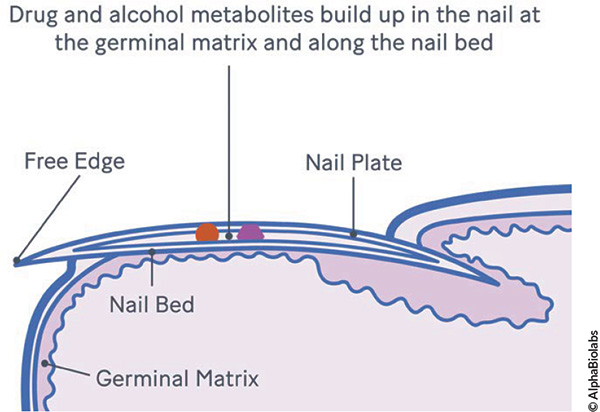
Once deposited, these markers remain stable, providing a retrospective overview of substance use.
Nail testing is especially useful when hair testing is unavailable or unsuitable. Common scenarios include:
In such instances, nail testing provides a robust alternative. It is also highly relevant in child protection cases, where long-term patterns of drug or alcohol use need to be evidenced swiftly to inform safeguarding decisions.
While nail testing can be conducted independently, its evidential power is amplified when used in conjunction with other testing methods. Combining nail drug or alcohol testing with hair, blood, urine or oral fluid analysis allows legal professionals to:
In alcohol testing, nail samples can complement blood biomarker testing – such as phosphatidylethanol (PEth) – to build a multi-source profile of alcohol use (proof of abstinence or supportive of chronic and excessive use). This is particularly valuable in care proceedings where establishing long-term parental behaviour is critical.
As toxicological science evolves, it’s essential for the legal profession to remain up to date on the full range of testing options available, particularly when decisions in court can have far-reaching consequences for families.
Nail testing offers a reliable means of evidencing long-term substance use and is effective as:

Marie Law is Director of Toxicology at AlphaBiolabs. A highly-skilled and respected scientist with over 15 years’ experience in the field of forensics, Marie joined AlphaBiolabs in 2022 and oversees the company’s growing toxicology team. As Director of Toxicology, Marie’s day-to-day responsibilities include maintaining the highest quality testing standards for toxicology and further enhancing AlphaBiolabs’ drug and alcohol testing services for the legal sector, members of the public, and the workplace sector.
As a leading provider of UKAS-accredited drug and alcohol testing, and a trusted training partner of the Judicial College, AlphaBiolabs recently had the opportunity to deliver a session on drug and alcohol testing to over 80 members of the judiciary.
Among the many insightful discussions that took place, there was a noticeable interest in alternative testing methods to complement hair testing – particularly nail testing.
Here, we take a closer look at nail drug and alcohol testing, its evidential value and how it can be used to support or enhance other toxicology evidence.
Nail testing is a toxicological method used to detect drug use or, in the case of nail alcohol testing, to monitor abstinence or chronic and excessive alcohol consumption over an extended period.
When a person consumes drugs or alcohol, these substances and their metabolites enter the bloodstream and become embedded in the keratin fibres of the nails as they grow.
Once deposited, these markers remain stable, providing a retrospective overview of substance use.
Nail testing is especially useful when hair testing is unavailable or unsuitable. Common scenarios include:
In such instances, nail testing provides a robust alternative. It is also highly relevant in child protection cases, where long-term patterns of drug or alcohol use need to be evidenced swiftly to inform safeguarding decisions.
While nail testing can be conducted independently, its evidential power is amplified when used in conjunction with other testing methods. Combining nail drug or alcohol testing with hair, blood, urine or oral fluid analysis allows legal professionals to:
In alcohol testing, nail samples can complement blood biomarker testing – such as phosphatidylethanol (PEth) – to build a multi-source profile of alcohol use (proof of abstinence or supportive of chronic and excessive use). This is particularly valuable in care proceedings where establishing long-term parental behaviour is critical.
As toxicological science evolves, it’s essential for the legal profession to remain up to date on the full range of testing options available, particularly when decisions in court can have far-reaching consequences for families.
Nail testing offers a reliable means of evidencing long-term substance use and is effective as:


Chair of the Bar finds common ground on legal services between our two jurisdictions, plus an update on jury trials
A £500 donation from AlphaBiolabs has been made to the leading UK charity tackling international parental child abduction and the movement of children across international borders
Marie Law, Director of Toxicology at AlphaBiolabs, outlines the drug and alcohol testing options available for family law professionals, and how a new, free guide can help identify the most appropriate testing method for each specific case
By Louise Crush of Westgate Wealth Management
Marie Law, Director of Toxicology at AlphaBiolabs, examines the latest ONS data on drug misuse and its implications for toxicology testing in family law cases
An interview with Rob Wagg, CEO of New Park Court Chambers
With at least 31 reports of AI hallucinations in UK legal cases – over 800 worldwide – and judges using AI to assist in judicial decision-making, the risks and benefits are impossible to ignore. Matthew Lee examines how different jurisdictions are responding
What has changed, and why? Paul Secher unpacks the new standards aligning the recruiting, training and appraising of judges – the first major change to the system for ten years
The deprivation of liberty is the most significant power the state can exercise. Drawing on frontline experience, Chris Henley KC explains why replacing trial by jury with judge-only trials risks undermining justice
Ever wondered what a pupillage is like at the CPS? This Q and A provides an insight into the training, experience and next steps
The appointments of 96 new King’s Counsel (also known as silk) are announced today