*/
Review by David Langwallner
This year marks the 30th anniversary of John Berendt’s Midnight in the Garden of Good and Evil: A Savannah Story, a non-fiction novel in the Southern Gothic tradition where the dominant themes are race, class divisions, religion, insanity – oh, and murder.
The book follows the real-life story of Jim Williams, a successful art and antiques dealer who was put on trial four times for the murder of his lover/employee, Danny Hanson. Berendt takes some liberties with the sequence of events and characters and, travelogue style, explores the place and the people of Savannah, Georgia and their eccentricities. The book was a near-instant best-seller, Pulitzer Prize (general nonfiction) finalist as well as generating much tourism in the area.
Savannah is a place of contradictions; home to some of the oldest courtly buildings in America ... and voodoo. The title refers to the witching hour near midnight where folk magic is replaced by evil magic. Savannah with much old wealth of puritan stock reacted ambivalently to Williams with his parvenu wealth, unconventional lifestyle and interest in alchemy and the spiritual world.
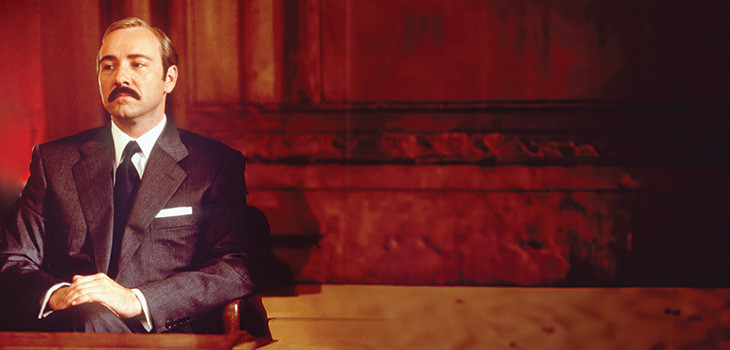
It also seized the interest of Clint Eastwood who turned the novel into a 1997 film with a screenplay by John Lee Hancock. The film version features Kevin Spacey (pictured above) as Williams and John Cusack as his journalist house guest John Kelso (representing Berendt). Kelso is writing a piece on Williams’ legendary Christmas parties when the shooting occurs and stays on to cover the murder trial. The victim, renamed as Billy Hanson in the film, is played by a young Jude Law.
One of Williams’ real-life lawyers, Sonny Seiler (played by Jack Thompson in the film) plays the part of the judge. (Seiler reportedly wanted the role of jury foreperson ‘because that would quietly stick my tongue out at a lot of people’ but was convinced he would be better suited as the judge.)
Lawyers, or rather the legal system, are not terribly favourably represented in Eastwood’s version. The film is also unsettling on prosecutorial zeal as well as flawed police procedure and features voodoo incantations by a priestess hired by Williams that he be acquitted. (A thought has occurred to me often that advocacy can appear a non-linear dark art itself.)
Now Williams was put on trial four times over five years and was eventually acquitted. The argument was self-defence and in effect proportionate force as he claimed that after an argument he had been attacked with a gun and merely responded. Of course, it raises the question of self-defence and the proportionate use of force not least in our increasingly vigilante age.
It also brings to the fore the issue of pretrial publicity. How can you get a fair trial if everyone knows who you are? Whatever they think of you. All juries were hung until the final one when the trial was moved out of Savannah. In the local juries everyone knew him, many wanted to hang him (literally or metaphorically), and many wanted to hang out with him. Prejudices and prejudgment. Williams died shortly after the fourth trial from the stress. Luckily at most and only exceptionally in the UK is there a second retrial.
Lawyers should, of course, and largely do in this jurisdiction, police carefully the distinction between morality and legality. American sentiments in that respect should not be followed. SCOTUS, as Lord Sumption has recently argued, are no longer in any meaningful sense judges but enforcers of dogma: ‘The United States has never stood in greater need of impartial constitutional arbiters in its highest court, and has never been further from getting them,’ he wrote in an article for Prospect Magazine. And, of course, all charges against President Elect Trump are now dropped. Thus, all lawyers worldwide be conscious of the witching hour and Midnight in the Garden of Good and Evil.
David Langwallner is a graduate of the Harvard Law School and the London School of Economics. He is a barrister at 1MCB and was 2015 Irish Lawyer of the Year for his work as director of the Irish Innocence Project.
This year marks the 30th anniversary of John Berendt’s Midnight in the Garden of Good and Evil: A Savannah Story, a non-fiction novel in the Southern Gothic tradition where the dominant themes are race, class divisions, religion, insanity – oh, and murder.
The book follows the real-life story of Jim Williams, a successful art and antiques dealer who was put on trial four times for the murder of his lover/employee, Danny Hanson. Berendt takes some liberties with the sequence of events and characters and, travelogue style, explores the place and the people of Savannah, Georgia and their eccentricities. The book was a near-instant best-seller, Pulitzer Prize (general nonfiction) finalist as well as generating much tourism in the area.
Savannah is a place of contradictions; home to some of the oldest courtly buildings in America ... and voodoo. The title refers to the witching hour near midnight where folk magic is replaced by evil magic. Savannah with much old wealth of puritan stock reacted ambivalently to Williams with his parvenu wealth, unconventional lifestyle and interest in alchemy and the spiritual world.
It also seized the interest of Clint Eastwood who turned the novel into a 1997 film with a screenplay by John Lee Hancock. The film version features Kevin Spacey (pictured above) as Williams and John Cusack as his journalist house guest John Kelso (representing Berendt). Kelso is writing a piece on Williams’ legendary Christmas parties when the shooting occurs and stays on to cover the murder trial. The victim, renamed as Billy Hanson in the film, is played by a young Jude Law.
One of Williams’ real-life lawyers, Sonny Seiler (played by Jack Thompson in the film) plays the part of the judge. (Seiler reportedly wanted the role of jury foreperson ‘because that would quietly stick my tongue out at a lot of people’ but was convinced he would be better suited as the judge.)
Lawyers, or rather the legal system, are not terribly favourably represented in Eastwood’s version. The film is also unsettling on prosecutorial zeal as well as flawed police procedure and features voodoo incantations by a priestess hired by Williams that he be acquitted. (A thought has occurred to me often that advocacy can appear a non-linear dark art itself.)
Now Williams was put on trial four times over five years and was eventually acquitted. The argument was self-defence and in effect proportionate force as he claimed that after an argument he had been attacked with a gun and merely responded. Of course, it raises the question of self-defence and the proportionate use of force not least in our increasingly vigilante age.
It also brings to the fore the issue of pretrial publicity. How can you get a fair trial if everyone knows who you are? Whatever they think of you. All juries were hung until the final one when the trial was moved out of Savannah. In the local juries everyone knew him, many wanted to hang him (literally or metaphorically), and many wanted to hang out with him. Prejudices and prejudgment. Williams died shortly after the fourth trial from the stress. Luckily at most and only exceptionally in the UK is there a second retrial.
Lawyers should, of course, and largely do in this jurisdiction, police carefully the distinction between morality and legality. American sentiments in that respect should not be followed. SCOTUS, as Lord Sumption has recently argued, are no longer in any meaningful sense judges but enforcers of dogma: ‘The United States has never stood in greater need of impartial constitutional arbiters in its highest court, and has never been further from getting them,’ he wrote in an article for Prospect Magazine. And, of course, all charges against President Elect Trump are now dropped. Thus, all lawyers worldwide be conscious of the witching hour and Midnight in the Garden of Good and Evil.
Review by David Langwallner

Chair of the Bar finds common ground on legal services between our two jurisdictions, plus an update on jury trials
A £500 donation from AlphaBiolabs has been made to the leading UK charity tackling international parental child abduction and the movement of children across international borders
Marie Law, Director of Toxicology at AlphaBiolabs, outlines the drug and alcohol testing options available for family law professionals, and how a new, free guide can help identify the most appropriate testing method for each specific case
By Louise Crush of Westgate Wealth Management
Marie Law, Director of Toxicology at AlphaBiolabs, examines the latest ONS data on drug misuse and its implications for toxicology testing in family law cases
An interview with Rob Wagg, CEO of New Park Court Chambers
With at least 31 reports of AI hallucinations in UK legal cases – over 800 worldwide – and judges using AI to assist in judicial decision-making, the risks and benefits are impossible to ignore. Matthew Lee examines how different jurisdictions are responding
What has changed, and why? Paul Secher unpacks the new standards aligning the recruiting, training and appraising of judges – the first major change to the system for ten years
The deprivation of liberty is the most significant power the state can exercise. Drawing on frontline experience, Chris Henley KC explains why replacing trial by jury with judge-only trials risks undermining justice
Ever wondered what a pupillage is like at the CPS? This Q and A provides an insight into the training, experience and next steps
The appointments of 96 new King’s Counsel (also known as silk) are announced today