*/
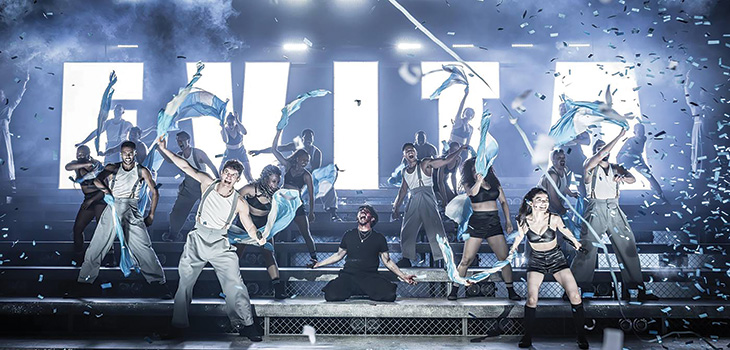

Don’t cry for me, Argentina; cry for your eardrums, because Jamie Lloyd cranks Andrew Lloyd Webber’s rock opera up to a decibel level usually reserved for Glastonbury.
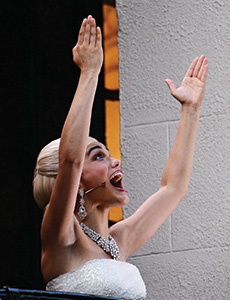
If you stroll down Argyll Street, you may find yourself swept into a throng gazing upward, as Rachel Zegler’s voice soars from the Palladium’s balcony. This moment, which will be talked about in a ‘I was there’ sense for years, is the centerpiece of Lloyd’s radical revival.
Evita is a sung-through musical biography by the powerhouse duo Andrew Lloyd Webber and Tim Rice. Since its 1978 West End debut, the show has become a touchstone of musical theatre, famous for its anthemic score and the enigmatic morality of its heroine. Evita dramatises the meteoric rise and tragic fall of Eva Perón, Argentina’s First Lady in the years following World War 2.
You are plunged into Eva’s world at the moment of her death, as the Argentine nation mourns. Flashbacks propel you into 1930s Argentina, where a teenage Eva Duarte, burning with ambition, claws her way from the provinces to Buenos Aires. The show’s opening numbers, ‘Oh What a Circus’ and ‘Buenos Aires’, set the tone: dazzling, relentless and brimming with contempt. Eva’s journey is a series of calculated seductions; of lovers, of the public, of power itself. She meets and marries Colonel Juan Perón, aligning her fate with his political ascent. Yet she is no mere consort; she becomes a populist icon, adored by the descamisados (the shirtless masses) and reviled by the elite.
As the narrative unfolds, you witness Eva’s transformation from actress to activist, from manipulator to martyr. Songs like ‘Rainbow High’ and ‘A New Argentina’ pulse with the energy of revolution. The show’s second act traces Eva’s philanthropic crusades, her declining health, and the mythmaking that surrounds her. The final moments, spare and haunting, leave you pondering the cost of ambition and the price of adoration.
Rachel Zegler’s Eva embodies the contradictions of a woman who is at once saint and sinner. Her vocal command is astonishing. Her ‘Don’t Cry for Me Argentina’ is jaw-dropping, delivered to both a crowd of spectators in Argyll Street from the Palladium balcony and to the auditorium via a cinematic live feed. Eva is steely, vulnerable, with palpable ambition yet also raw tenderness shown in her dying song, ‘You Must Love Me’.
Diego Andres Rodriguez’s Che Guevara (who narrates the show and acts as its moral compass, although there is no evidence Che and Evita ever met) is magnetic. His performance crackles with sardonic irony and anger; his ‘High Flying, Adored’ a masterclass in understated heartbreak. Rodriguez’s Che is less the revolutionary icon of history and more an everyman, watching and judging.
The choreography is relentless. Dancers stomp, pose and writhe across an industrial staircase set, conjuring both the fervor of a rally and the chaos of a revolution. The ensemble is a living, breathing organism, their movements at times militaristic, at times sensual. Numbers like ‘A New Argentina’ and ‘And the Money Kept Rolling In’ build to ecstatic climaxes, the choreography amplifying the show’s themes of power and spectacle.
Compared to earlier productions, such as Hal Prince and Elaine Page’s original version, Michael Grandage’s Argentine revival or Elena Rogers’ magnificent performance in 2006, this Evita is both more and less. It is more spectacle, more sensation, more risk. It is less concerned with historical accuracy or narrative clarity. In spirit, it recalls the iconoclasm of Cabaret and the raw energy of Spring Awakening, while its use of live video evokes the multimedia wizardry of Lloyd’s Sunset Boulevard.
This is theatre that matters: urgent, unsettling, unforgettable. By the time you read this, I suspect the show will have sold out. But try to get a ticket if you possibly can.

Daniel Barnett practises from Outer Temple Chambers and presents the legal hour on LBC Radio.
Don’t cry for me, Argentina; cry for your eardrums, because Jamie Lloyd cranks Andrew Lloyd Webber’s rock opera up to a decibel level usually reserved for Glastonbury.
If you stroll down Argyll Street, you may find yourself swept into a throng gazing upward, as Rachel Zegler’s voice soars from the Palladium’s balcony. This moment, which will be talked about in a ‘I was there’ sense for years, is the centerpiece of Lloyd’s radical revival.
Evita is a sung-through musical biography by the powerhouse duo Andrew Lloyd Webber and Tim Rice. Since its 1978 West End debut, the show has become a touchstone of musical theatre, famous for its anthemic score and the enigmatic morality of its heroine. Evita dramatises the meteoric rise and tragic fall of Eva Perón, Argentina’s First Lady in the years following World War 2.
You are plunged into Eva’s world at the moment of her death, as the Argentine nation mourns. Flashbacks propel you into 1930s Argentina, where a teenage Eva Duarte, burning with ambition, claws her way from the provinces to Buenos Aires. The show’s opening numbers, ‘Oh What a Circus’ and ‘Buenos Aires’, set the tone: dazzling, relentless and brimming with contempt. Eva’s journey is a series of calculated seductions; of lovers, of the public, of power itself. She meets and marries Colonel Juan Perón, aligning her fate with his political ascent. Yet she is no mere consort; she becomes a populist icon, adored by the descamisados (the shirtless masses) and reviled by the elite.
As the narrative unfolds, you witness Eva’s transformation from actress to activist, from manipulator to martyr. Songs like ‘Rainbow High’ and ‘A New Argentina’ pulse with the energy of revolution. The show’s second act traces Eva’s philanthropic crusades, her declining health, and the mythmaking that surrounds her. The final moments, spare and haunting, leave you pondering the cost of ambition and the price of adoration.
Rachel Zegler’s Eva embodies the contradictions of a woman who is at once saint and sinner. Her vocal command is astonishing. Her ‘Don’t Cry for Me Argentina’ is jaw-dropping, delivered to both a crowd of spectators in Argyll Street from the Palladium balcony and to the auditorium via a cinematic live feed. Eva is steely, vulnerable, with palpable ambition yet also raw tenderness shown in her dying song, ‘You Must Love Me’.
Diego Andres Rodriguez’s Che Guevara (who narrates the show and acts as its moral compass, although there is no evidence Che and Evita ever met) is magnetic. His performance crackles with sardonic irony and anger; his ‘High Flying, Adored’ a masterclass in understated heartbreak. Rodriguez’s Che is less the revolutionary icon of history and more an everyman, watching and judging.
The choreography is relentless. Dancers stomp, pose and writhe across an industrial staircase set, conjuring both the fervor of a rally and the chaos of a revolution. The ensemble is a living, breathing organism, their movements at times militaristic, at times sensual. Numbers like ‘A New Argentina’ and ‘And the Money Kept Rolling In’ build to ecstatic climaxes, the choreography amplifying the show’s themes of power and spectacle.
Compared to earlier productions, such as Hal Prince and Elaine Page’s original version, Michael Grandage’s Argentine revival or Elena Rogers’ magnificent performance in 2006, this Evita is both more and less. It is more spectacle, more sensation, more risk. It is less concerned with historical accuracy or narrative clarity. In spirit, it recalls the iconoclasm of Cabaret and the raw energy of Spring Awakening, while its use of live video evokes the multimedia wizardry of Lloyd’s Sunset Boulevard.
This is theatre that matters: urgent, unsettling, unforgettable. By the time you read this, I suspect the show will have sold out. But try to get a ticket if you possibly can.

Chair of the Bar finds common ground on legal services between our two jurisdictions, plus an update on jury trials
A £500 donation from AlphaBiolabs has been made to the leading UK charity tackling international parental child abduction and the movement of children across international borders
Marie Law, Director of Toxicology at AlphaBiolabs, outlines the drug and alcohol testing options available for family law professionals, and how a new, free guide can help identify the most appropriate testing method for each specific case
By Louise Crush of Westgate Wealth Management
Marie Law, Director of Toxicology at AlphaBiolabs, examines the latest ONS data on drug misuse and its implications for toxicology testing in family law cases
An interview with Rob Wagg, CEO of New Park Court Chambers
With at least 31 reports of AI hallucinations in UK legal cases – over 800 worldwide – and judges using AI to assist in judicial decision-making, the risks and benefits are impossible to ignore. Matthew Lee examines how different jurisdictions are responding
What has changed, and why? Paul Secher unpacks the new standards aligning the recruiting, training and appraising of judges – the first major change to the system for ten years
The deprivation of liberty is the most significant power the state can exercise. Drawing on frontline experience, Chris Henley KC explains why replacing trial by jury with judge-only trials risks undermining justice
Ever wondered what a pupillage is like at the CPS? This Q and A provides an insight into the training, experience and next steps
The appointments of 96 new King’s Counsel (also known as silk) are announced today