*/
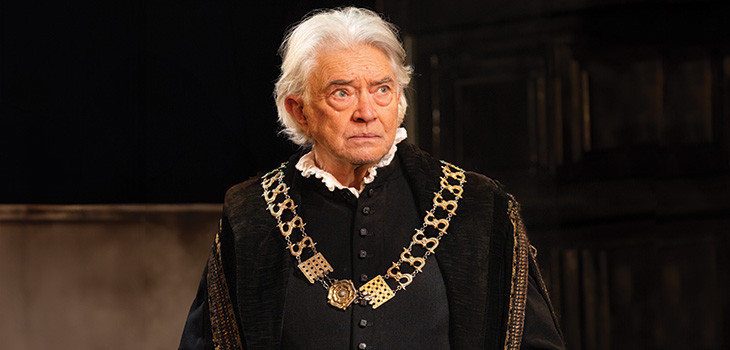

Martin Shaw (better known as Judge John Deed, or Doyle from The Professionals) is back portraying Sir Thomas More 15 years after he last did so in the West End.
Robert Bolt’s award-winning play, directed by Jonathan Church, offers a timely exploration of power and the price of standing firm in one’s convictions. It’s about the man who dared to defy a king. Set against the backdrop of Henry VIII’s England, the play chronicles More’s journey from respected scholar and friend of the King to a prisoner of conscience. As Henry seeks to divorce Catherine of Aragon and marry Anne Boleyn, More finds himself caught between his loyalty to the crown and his unwavering Catholic faith.
The writing is outstanding. Occasionally funny, and often deeply moving, it is also an exercise in philosophical and liturgical sophistry. My brain fizzed as I absorbed the competing theological arguments on both sides. It’s impossible not to admire the intellectual dexterity of More v Cromwell, captured perfectly in this script.
The play features the well-known scene where Sir Thomas More debates William Roper about the importance of law. Roper, angered that More won’t arrest someone dangerous without legal cause, accuses him of giving ‘the Devil benefit of law’. More responds with a powerful argument: if we ‘cut down every law’ to get at the Devil, where would we hide when the Devil turns on us? He argues that laws protect everyone, concluding with the famous line sometimes quoted in modern courtroom dramas: ‘Yes, I’d give the Devil benefit of law, for my own safety’s sake.’
Shaw was born to play this part. He brings a commanding presence to the role of Thomas More, capturing his sharp intellect and his deep moral struggle. His resonant baritone dominates the stage (and he’s 80 years old – can you believe it?). His More is not a sanctimonious martyr but a man of flesh and blood, grappling with the consequences of his principles. You can see the pride in his eyes when his daughter, Lady Margaret, is introduced to the King and speaks with him in Latin. Yet as the second half progresses, he visibly ages and weakens as he falls out of favour with the King. And in a poignant scene, Shaw’s More bids farewell to his family in the Tower of London, his voice barely above a whisper as he explains why he cannot bend to the King’s will. It’s a masterclass in understated emotion, reminiscent of Paul Scofield’s iconic portrayal in the 1966 film, yet distinctly Shaw’s own.
The supporting cast matches Shaw’s excellence. Gary Wilmot brings a touch of comedy as the Common Man, serving as both narrator and everyman, his wry observations providing a counterpoint to the weighty moral dilemmas unfolding on stage. This production has the Common Man transform into various characters throughout the play, from a boatman to Thomas More’s jailer, as well as the foreman of the jury that condemns More, showcasing Wilmot’s versatility and underscoring the idea that ordinary people are often complicit in, or victims of, the machinations of the powerful. He reminded me of clerks 20 or 30 years ago, displaying a pretence of politeness while simultaneously mocking, perhaps even despising, the people he works for.
Edward Bennett’s Thomas Cromwell is a study in calculated ambition, his silky menace growing as More’s fortunes wane. Abigail Cruttenden brings depth to Alice More, transforming what could be a thankless role into a portrait of a woman torn between love for her husband and fear for her family’s future.
As More’s refusal to endorse the King’s actions leads to his downfall, you’re drawn into a world where personal integrity clashes violently with political expediency. The play’s themes resonate strongly in our current climate, where the concept of ‘alternative facts’ often seems to trump objective truth.
One of the production’s strengths lies in its pacing. The first act builds slowly, establishing the political landscape and More’s position within it. By the time Henry VIII makes his entrance – Orlando James capturing the King’s charisma and volatility in equal measure – the stage is set for the conflict to come. The second act ratchets up the tension, with More’s trial scene providing a gripping climax that leaves you on the edge of your seat, even though you know the outcome. As he concludes with the words: ‘What you have hated me for is not my actions, but the thoughts of my heart,’ you realise the show offers no easy answers, but invites you to grapple with questions that are as relevant today as they were in Tudor England. Are the demands of allegiance to the Church in the face of one’s personal conscience any different from demands of allegiance to today’s demagogic leaders?
A Man For All Seasons is on national tour

Daniel Barnett practises from Outer Temple Chambers and presents the legal hour on LBC Radio.
Martin Shaw (better known as Judge John Deed, or Doyle from The Professionals) is back portraying Sir Thomas More 15 years after he last did so in the West End.
Robert Bolt’s award-winning play, directed by Jonathan Church, offers a timely exploration of power and the price of standing firm in one’s convictions. It’s about the man who dared to defy a king. Set against the backdrop of Henry VIII’s England, the play chronicles More’s journey from respected scholar and friend of the King to a prisoner of conscience. As Henry seeks to divorce Catherine of Aragon and marry Anne Boleyn, More finds himself caught between his loyalty to the crown and his unwavering Catholic faith.
The writing is outstanding. Occasionally funny, and often deeply moving, it is also an exercise in philosophical and liturgical sophistry. My brain fizzed as I absorbed the competing theological arguments on both sides. It’s impossible not to admire the intellectual dexterity of More v Cromwell, captured perfectly in this script.
The play features the well-known scene where Sir Thomas More debates William Roper about the importance of law. Roper, angered that More won’t arrest someone dangerous without legal cause, accuses him of giving ‘the Devil benefit of law’. More responds with a powerful argument: if we ‘cut down every law’ to get at the Devil, where would we hide when the Devil turns on us? He argues that laws protect everyone, concluding with the famous line sometimes quoted in modern courtroom dramas: ‘Yes, I’d give the Devil benefit of law, for my own safety’s sake.’
Shaw was born to play this part. He brings a commanding presence to the role of Thomas More, capturing his sharp intellect and his deep moral struggle. His resonant baritone dominates the stage (and he’s 80 years old – can you believe it?). His More is not a sanctimonious martyr but a man of flesh and blood, grappling with the consequences of his principles. You can see the pride in his eyes when his daughter, Lady Margaret, is introduced to the King and speaks with him in Latin. Yet as the second half progresses, he visibly ages and weakens as he falls out of favour with the King. And in a poignant scene, Shaw’s More bids farewell to his family in the Tower of London, his voice barely above a whisper as he explains why he cannot bend to the King’s will. It’s a masterclass in understated emotion, reminiscent of Paul Scofield’s iconic portrayal in the 1966 film, yet distinctly Shaw’s own.
The supporting cast matches Shaw’s excellence. Gary Wilmot brings a touch of comedy as the Common Man, serving as both narrator and everyman, his wry observations providing a counterpoint to the weighty moral dilemmas unfolding on stage. This production has the Common Man transform into various characters throughout the play, from a boatman to Thomas More’s jailer, as well as the foreman of the jury that condemns More, showcasing Wilmot’s versatility and underscoring the idea that ordinary people are often complicit in, or victims of, the machinations of the powerful. He reminded me of clerks 20 or 30 years ago, displaying a pretence of politeness while simultaneously mocking, perhaps even despising, the people he works for.
Edward Bennett’s Thomas Cromwell is a study in calculated ambition, his silky menace growing as More’s fortunes wane. Abigail Cruttenden brings depth to Alice More, transforming what could be a thankless role into a portrait of a woman torn between love for her husband and fear for her family’s future.
As More’s refusal to endorse the King’s actions leads to his downfall, you’re drawn into a world where personal integrity clashes violently with political expediency. The play’s themes resonate strongly in our current climate, where the concept of ‘alternative facts’ often seems to trump objective truth.
One of the production’s strengths lies in its pacing. The first act builds slowly, establishing the political landscape and More’s position within it. By the time Henry VIII makes his entrance – Orlando James capturing the King’s charisma and volatility in equal measure – the stage is set for the conflict to come. The second act ratchets up the tension, with More’s trial scene providing a gripping climax that leaves you on the edge of your seat, even though you know the outcome. As he concludes with the words: ‘What you have hated me for is not my actions, but the thoughts of my heart,’ you realise the show offers no easy answers, but invites you to grapple with questions that are as relevant today as they were in Tudor England. Are the demands of allegiance to the Church in the face of one’s personal conscience any different from demands of allegiance to today’s demagogic leaders?
A Man For All Seasons is on national tour


Chair of the Bar finds common ground on legal services between our two jurisdictions, plus an update on jury trials
A £500 donation from AlphaBiolabs has been made to the leading UK charity tackling international parental child abduction and the movement of children across international borders
Marie Law, Director of Toxicology at AlphaBiolabs, outlines the drug and alcohol testing options available for family law professionals, and how a new, free guide can help identify the most appropriate testing method for each specific case
By Louise Crush of Westgate Wealth Management
Marie Law, Director of Toxicology at AlphaBiolabs, examines the latest ONS data on drug misuse and its implications for toxicology testing in family law cases
An interview with Rob Wagg, CEO of New Park Court Chambers
With at least 31 reports of AI hallucinations in UK legal cases – over 800 worldwide – and judges using AI to assist in judicial decision-making, the risks and benefits are impossible to ignore. Matthew Lee examines how different jurisdictions are responding
What has changed, and why? Paul Secher unpacks the new standards aligning the recruiting, training and appraising of judges – the first major change to the system for ten years
The deprivation of liberty is the most significant power the state can exercise. Drawing on frontline experience, Chris Henley KC explains why replacing trial by jury with judge-only trials risks undermining justice
Ever wondered what a pupillage is like at the CPS? This Q and A provides an insight into the training, experience and next steps
The appointments of 96 new King’s Counsel (also known as silk) are announced today