*/
The Bar Council has been running a joint roadshow with the BSB to initiate a debate on the business implications and opportunities presented by the Legal Services Act 2007 and the BSB’s rule changes. Paul Mosson and Ariel Ricci report back.
On 20 November 2009 the Bar Standards Board (“BSB”) announced decisions that have the potential to change the face of the Bar as we know it. While the BSB waits for these proposed changes to be approved by the Legal Services Board (“LSB”), the Bar Council put into motion a plan of action to begin educating and obtaining feedback from the profession. Last December, the Circuit Leaders, together with the Chairman of the Bar, Nick Green QC, and the BSB began scheduling a national roadshow to initiate a debate about how the profession can not only survive, but grow stronger and retain its unique attributes.
A member of the BSB joined the Leader of each Circuit and the Chairman of the Bar on the panel to explain the business implications and opportunities presented by the Legal Services Act 2007 (“the 2007 Act”) and the BSB’s rule changes. They discussed some of the opportunities for chambers to be competitive in a rapidly developing market, and the audience spoke frankly about their views on the current and future state of the Bar. Unsurprisingly, some individuals were more optimistic about the changes than others.
Issues raised in the discussions
Many in the audiences have asked: “How can we compete with solicitors for block-contracts when the Bar doesn’t have the infrastructure?” or “How can block-contracting be profitable for chambers when competing with firms of solicitors?” There are no definitive answers to these questions but information received during chambers’ visits indicates that in civil and commercial work, chambers can be 60–80 per cent more efficient to operate in cost terms than comparable firms of solicitors, which gives the Bar a very strong competitive edge on price, to say nothing of quality.
The infrastructure currently missing to enable the Bar to compete can be provided for by a procurement company (appropriately, if unimaginatively, called “ProcureCo”). ProcureCo is a generic term used for a company, or other incorporated entity, which administers and procures legal services. Some types of ProcureCo can be used under the rules as they exist today in order to bid for block contracts with large purchasers of legal services. The Bar Council will be publishing sample contractual terms and a complete guide in early April.
The Bar Chairman was also asked, “How is it in the interests of the referral Bar to bid against the very people who feed it work?” and “If we compete on the grounds of high quality and not just competitive tenders, do we not run the risk of alienating those firms who have in-house HCAs?”
How individual firms of solicitors will react to the referral Bar competing directly with them is currently a matter of conjecture. Many, and in particular those at the Criminal Bar, have forcefully expressed the view that the Bar simply has no options. As one very senior member of the profession and former Circuit Leader put it: “It is compete or die by a thousand cuts.”
The junior Bar
On 11 March the Bar Council’s Young Barristers’ Committee hosted a roadshow seminar for barristers under 10 years’ Call. The seminar included videolinks from Birmingham, Leeds, Liverpool and Swansea (for a full report see the May issue of Counsel). As they will have to live with the changes for decades to come, it is vital that the Young Bar understands the changes and opportunities; that they feel engaged with the decision
Increased opportunities
A number of other themes emerged during the course of the roadshow and the Chairman’s discussions with barristers, clerks and practice managers in chambers. The growth in work handled by higher court advocates and the increase in CPS in-house advocacy were often raised as sources of concern and frustration. There was demoralisation due to the Ministry of Justice’s proposed cuts to legal aid. Fears were expressed about the future of the self-employed Bar. But some barristers and clerks spoke positively of the opportunities that increased direct access might offer the Bar, while others talked of creative ways to bid for work with local authorities and the Legal Services Commission.
The role of the Bar Council
There are no easy answers. The Bar Council aims to guide the Bar through the challenging years ahead. The BSB will begin consulting with the Bar later this year on whether it should become a regulator of entities (such as barrister-only or barrister-majority partnerships), or whether it should leave entity regulation to the Solicitors Regulation Authority. We urge everyone to participate in that process.
Maintaining the momentum
The Chairman of the Bar and the Bar Council still need to hear more from the Bar. By the time the 25th Annual Bar Conference is held in London on 6 November 2010 we hope to have an even better understanding of how the legal services market is developing, and where the future of the Bar lies for many practitioners. If ever there was a reason to attend the Bar’s flagship event this must be it. In the meantime the Circuit Leaders have committed to maintain the momentum of discussion and debate by setting up local forums in which members of the Bar can participate on a regional level. Details are on the Circuit websites or they can be found by contacting the Circuit Administrators.
Further information
The Bar Council has prepared a set of documents which explain the BSB’s changes and the business model concept we have come to know as ProcureCo. If you did not manage to pick up these materials from any of the roadshows, they can be downloaded from the Bar Council’s website (www.barcouncil.org.uk/news/latest/502.html).
Paul Mosson is the Head of Member Services. Ariel Ricci is the Executive Assistant to the Chairman of the Bar Council.
The new working practices
In November 2009 the BSB made historic changes to the way in which barristers can supply legal services by accepting the following recommendations:
A member of the BSB joined the Leader of each Circuit and the Chairman of the Bar on the panel to explain the business implications and opportunities presented by the Legal Services Act 2007 (“the 2007 Act”) and the BSB’s rule changes. They discussed some of the opportunities for chambers to be competitive in a rapidly developing market, and the audience spoke frankly about their views on the current and future state of the Bar. Unsurprisingly, some individuals were more optimistic about the changes than others.
Issues raised in the discussions
Many in the audiences have asked: “How can we compete with solicitors for block-contracts when the Bar doesn’t have the infrastructure?” or “How can block-contracting be profitable for chambers when competing with firms of solicitors?” There are no definitive answers to these questions but information received during chambers’ visits indicates that in civil and commercial work, chambers can be 60–80 per cent more efficient to operate in cost terms than comparable firms of solicitors, which gives the Bar a very strong competitive edge on price, to say nothing of quality.
The infrastructure currently missing to enable the Bar to compete can be provided for by a procurement company (appropriately, if unimaginatively, called “ProcureCo”). ProcureCo is a generic term used for a company, or other incorporated entity, which administers and procures legal services. Some types of ProcureCo can be used under the rules as they exist today in order to bid for block contracts with large purchasers of legal services. The Bar Council will be publishing sample contractual terms and a complete guide in early April.
The Bar Chairman was also asked, “How is it in the interests of the referral Bar to bid against the very people who feed it work?” and “If we compete on the grounds of high quality and not just competitive tenders, do we not run the risk of alienating those firms who have in-house HCAs?”
How individual firms of solicitors will react to the referral Bar competing directly with them is currently a matter of conjecture. Many, and in particular those at the Criminal Bar, have forcefully expressed the view that the Bar simply has no options. As one very senior member of the profession and former Circuit Leader put it: “It is compete or die by a thousand cuts.”
The junior Bar
On 11 March the Bar Council’s Young Barristers’ Committee hosted a roadshow seminar for barristers under 10 years’ Call. The seminar included videolinks from Birmingham, Leeds, Liverpool and Swansea (for a full report see the May issue of Counsel). As they will have to live with the changes for decades to come, it is vital that the Young Bar understands the changes and opportunities; that they feel engaged with the decision
Increased opportunities
A number of other themes emerged during the course of the roadshow and the Chairman’s discussions with barristers, clerks and practice managers in chambers. The growth in work handled by higher court advocates and the increase in CPS in-house advocacy were often raised as sources of concern and frustration. There was demoralisation due to the Ministry of Justice’s proposed cuts to legal aid. Fears were expressed about the future of the self-employed Bar. But some barristers and clerks spoke positively of the opportunities that increased direct access might offer the Bar, while others talked of creative ways to bid for work with local authorities and the Legal Services Commission.
The role of the Bar Council
There are no easy answers. The Bar Council aims to guide the Bar through the challenging years ahead. The BSB will begin consulting with the Bar later this year on whether it should become a regulator of entities (such as barrister-only or barrister-majority partnerships), or whether it should leave entity regulation to the Solicitors Regulation Authority. We urge everyone to participate in that process.
Maintaining the momentum
The Chairman of the Bar and the Bar Council still need to hear more from the Bar. By the time the 25th Annual Bar Conference is held in London on 6 November 2010 we hope to have an even better understanding of how the legal services market is developing, and where the future of the Bar lies for many practitioners. If ever there was a reason to attend the Bar’s flagship event this must be it. In the meantime the Circuit Leaders have committed to maintain the momentum of discussion and debate by setting up local forums in which members of the Bar can participate on a regional level. Details are on the Circuit websites or they can be found by contacting the Circuit Administrators.
Further information
The Bar Council has prepared a set of documents which explain the BSB’s changes and the business model concept we have come to know as ProcureCo. If you did not manage to pick up these materials from any of the roadshows, they can be downloaded from the Bar Council’s website (www.barcouncil.org.uk/news/latest/502.html).
Paul Mosson is the Head of Member Services. Ariel Ricci is the Executive Assistant to the Chairman of the Bar Council.
The new working practices
In November 2009 the BSB made historic changes to the way in which barristers can supply legal services by accepting the following recommendations:
The Bar Council has been running a joint roadshow with the BSB to initiate a debate on the business implications and opportunities presented by the Legal Services Act 2007 and the BSB’s rule changes. Paul Mosson and Ariel Ricci report back.
On 20 November 2009 the Bar Standards Board (“BSB”) announced decisions that have the potential to change the face of the Bar as we know it. While the BSB waits for these proposed changes to be approved by the Legal Services Board (“LSB”), the Bar Council put into motion a plan of action to begin educating and obtaining feedback from the profession. Last December, the Circuit Leaders, together with the Chairman of the Bar, Nick Green QC, and the BSB began scheduling a national roadshow to initiate a debate about how the profession can not only survive, but grow stronger and retain its unique attributes.
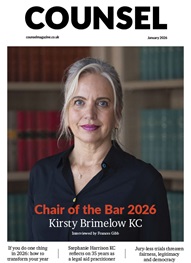

Kirsty Brimelow KC, Chair of the Bar, sets our course for 2026
What meaningful steps can you take in 2026 to advance your legal career? asks Thomas Cowan of St Pauls Chambers
Marie Law, Director of Toxicology at AlphaBiolabs, explains why drugs may appear in test results, despite the donor denying use of them
Asks Louise Crush of Westgate Wealth Management
AlphaBiolabs has donated £500 to The Christie Charity through its Giving Back initiative, helping to support cancer care, treatment and research across Greater Manchester, Cheshire and further afield
Q and A with criminal barrister Nick Murphy, who moved to New Park Court Chambers on the North Eastern Circuit in search of a better work-life balance
The appointments of 96 new King’s Counsel (also known as silk) are announced today
With pupillage application season under way, Laura Wright reflects on her route to ‘tech barrister’ and offers advice for those aiming at a career at the Bar
Jury-less trial proposals threaten fairness, legitimacy and democracy without ending the backlog, writes Professor Cheryl Thomas KC (Hon), the UK’s leading expert on juries, judges and courts
Are you ready for the new way to do tax returns? David Southern KC explains the biggest change since HMRC launched self-assessment more than 30 years ago... and its impact on the Bar
Marking one year since a Bar disciplinary tribunal dismissed all charges against her, Dr Charlotte Proudman discusses the experience, her formative years and next steps. Interview by Anthony Inglese CB