*/
As the new Legal Year begins, Desmond Browne QC stresses the importance of access to justice for all
Perhaps attracted by the opportunity for a guided tour round our new Supreme Court, leaders of legal professions from overseas attended the events marking the Opening of the Legal Year in larger numbers than ever before. There were no less than 40 from jurisdictions ranging from Argentina to Zimbabwe via Mauritius and Mexico. It was clear from speaking to our guests that they were not simply attracted by the hundreds of wigs and gowns gathering in the Abbey, they were motivated by genuine admiration for the manner in which our legal system, its practitioners and judges put our common commitment to access to justice into practice. This year, in the gathering economic storm, there was a consciousness that it was never more vital that ordinary citizens should be able to enforce and defend their rights.
Ours is not only the jurisdiction where the legal aid budget is under pressure, but in no other jurisdiction does it seem that cuts are being inflicted of the enormity of those proposed here. At our meeting on 30 September the Bar leaders were unanimous that the state’s duty to provide legal aid stems from the commitment to the rule of law, and that means nothing if individuals cannot obtain effective access to justice. From our discussions two themes emerged:
Our meeting ended with a resolution I can only hope reverberates throughout the MoJ. It urged governments to provide adequate funding to ensure access to justice for all, regardless of social or ethnic background, gender or the nature of their cause. In return the signatories resolved to encourage lawyers to continue undertaking fairly remunerated publicly-funded work, as well as pro bono work, always recognising that the latter can never operate as a substitute for properly funded state legal aid.
One of the guests attending the Opening of the Legal Year was Josephat Tshuma, the President of the Zimbabwe Law Society. He has shown himself to be a doughty advocate of constitutional change and impartial justice at grave risk to his safety and his career. At the Labour Party Conference in Brighton, I shared a platform with Josephat’s predecessor, the inspiring Beatrice Mtetwa, who has more than once suffered unlawful detention and beating for her pains in trying to keep the flame of human rights alight. I hope to see them both again soon in Harare.
At the end of October Mohamed Husain (the South African President of the Commonwealth Lawyers Association) and I will be leading a fact-finding mission to Zimbabwe organised by the Bar Human Rights Committee chaired by Mark Muller QC. Joining us will be three Belgian and Dutch lawyers from Avocats Sans Frontières. The aim of the visit is to discover what difference the first 100 days of the Unity Government between ZANU/PF and the MDC has made to respect for the constitution and adherence to the rule of law. It will be a timely visit, not least because Morgan Tsvangirai of the MDC has just received the Human Rights Prize of the International Bar Association at their meeting in Madrid.
The day this column goes to the printers the Queen will be performing the Official Opening of the Supreme Court. As yet there is no sign in Parliament Square of anything like the Supreme Court Advocacy Institute which exists in Ottawa. The Institute (a registered charity) provides free, non-partisan forensic advice to lawyers prior to their appearance in the Supreme Court of Canada. The advice is provided by a panel before whom counsel practise their oral argument. The panel consists of three or more members drawn from senior counsel, law professors and former Supreme Court law clerks. The Chief Justice of Canada, Beverley McLachlin, has praised the scheme as providing both novice and experienced counsel with a forum in which to refine their advocacy. Would it work here? There are not many of us who can claim our appellate advocacy is incapable of improvement.
Last year Tim Dutton crossed swords with Peter Moffat over the portrayal of barristers in the first series of Criminal Justice. This year he deserves our thanks. Writing in the Daily Telegraph about the government’s proposals to slash family legal aid funding, he says: “Family barristers dealing with unbelievably complex cases will be working for shockingly low pay”. I hope someone from the MoJ has been watching.
Desmond Browne QC is Bar Chairman
Perhaps attracted by the opportunity for a guided tour round our new Supreme Court, leaders of legal professions from overseas attended the events marking the Opening of the Legal Year in larger numbers than ever before. There were no less than 40 from jurisdictions ranging from Argentina to Zimbabwe via Mauritius and Mexico. It was clear from speaking to our guests that they were not simply attracted by the hundreds of wigs and gowns gathering in the Abbey, they were motivated by genuine admiration for the manner in which our legal system, its practitioners and judges put our common commitment to access to justice into practice. This year, in the gathering economic storm, there was a consciousness that it was never more vital that ordinary citizens should be able to enforce and defend their rights.
Ours is not only the jurisdiction where the legal aid budget is under pressure, but in no other jurisdiction does it seem that cuts are being inflicted of the enormity of those proposed here. At our meeting on 30 September the Bar leaders were unanimous that the state’s duty to provide legal aid stems from the commitment to the rule of law, and that means nothing if individuals cannot obtain effective access to justice. From our discussions two themes emerged:
Our meeting ended with a resolution I can only hope reverberates throughout the MoJ. It urged governments to provide adequate funding to ensure access to justice for all, regardless of social or ethnic background, gender or the nature of their cause. In return the signatories resolved to encourage lawyers to continue undertaking fairly remunerated publicly-funded work, as well as pro bono work, always recognising that the latter can never operate as a substitute for properly funded state legal aid.
One of the guests attending the Opening of the Legal Year was Josephat Tshuma, the President of the Zimbabwe Law Society. He has shown himself to be a doughty advocate of constitutional change and impartial justice at grave risk to his safety and his career. At the Labour Party Conference in Brighton, I shared a platform with Josephat’s predecessor, the inspiring Beatrice Mtetwa, who has more than once suffered unlawful detention and beating for her pains in trying to keep the flame of human rights alight. I hope to see them both again soon in Harare.
At the end of October Mohamed Husain (the South African President of the Commonwealth Lawyers Association) and I will be leading a fact-finding mission to Zimbabwe organised by the Bar Human Rights Committee chaired by Mark Muller QC. Joining us will be three Belgian and Dutch lawyers from Avocats Sans Frontières. The aim of the visit is to discover what difference the first 100 days of the Unity Government between ZANU/PF and the MDC has made to respect for the constitution and adherence to the rule of law. It will be a timely visit, not least because Morgan Tsvangirai of the MDC has just received the Human Rights Prize of the International Bar Association at their meeting in Madrid.
The day this column goes to the printers the Queen will be performing the Official Opening of the Supreme Court. As yet there is no sign in Parliament Square of anything like the Supreme Court Advocacy Institute which exists in Ottawa. The Institute (a registered charity) provides free, non-partisan forensic advice to lawyers prior to their appearance in the Supreme Court of Canada. The advice is provided by a panel before whom counsel practise their oral argument. The panel consists of three or more members drawn from senior counsel, law professors and former Supreme Court law clerks. The Chief Justice of Canada, Beverley McLachlin, has praised the scheme as providing both novice and experienced counsel with a forum in which to refine their advocacy. Would it work here? There are not many of us who can claim our appellate advocacy is incapable of improvement.
Last year Tim Dutton crossed swords with Peter Moffat over the portrayal of barristers in the first series of Criminal Justice. This year he deserves our thanks. Writing in the Daily Telegraph about the government’s proposals to slash family legal aid funding, he says: “Family barristers dealing with unbelievably complex cases will be working for shockingly low pay”. I hope someone from the MoJ has been watching.
Desmond Browne QC is Bar Chairman
As the new Legal Year begins, Desmond Browne QC stresses the importance of access to justice for all
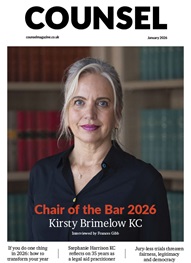

Kirsty Brimelow KC, Chair of the Bar, sets our course for 2026
What meaningful steps can you take in 2026 to advance your legal career? asks Thomas Cowan of St Pauls Chambers
Marie Law, Director of Toxicology at AlphaBiolabs, explains why drugs may appear in test results, despite the donor denying use of them
Asks Louise Crush of Westgate Wealth Management
AlphaBiolabs has donated £500 to The Christie Charity through its Giving Back initiative, helping to support cancer care, treatment and research across Greater Manchester, Cheshire and further afield
Q and A with criminal barrister Nick Murphy, who moved to New Park Court Chambers on the North Eastern Circuit in search of a better work-life balance
The appointments of 96 new King’s Counsel (also known as silk) are announced today
With pupillage application season under way, Laura Wright reflects on her route to ‘tech barrister’ and offers advice for those aiming at a career at the Bar
Jury-less trial proposals threaten fairness, legitimacy and democracy without ending the backlog, writes Professor Cheryl Thomas KC (Hon), the UK’s leading expert on juries, judges and courts
Are you ready for the new way to do tax returns? David Southern KC explains the biggest change since HMRC launched self-assessment more than 30 years ago... and its impact on the Bar
Marking one year since a Bar disciplinary tribunal dismissed all charges against her, Dr Charlotte Proudman discusses the experience, her formative years and next steps. Interview by Anthony Inglese CB