*/
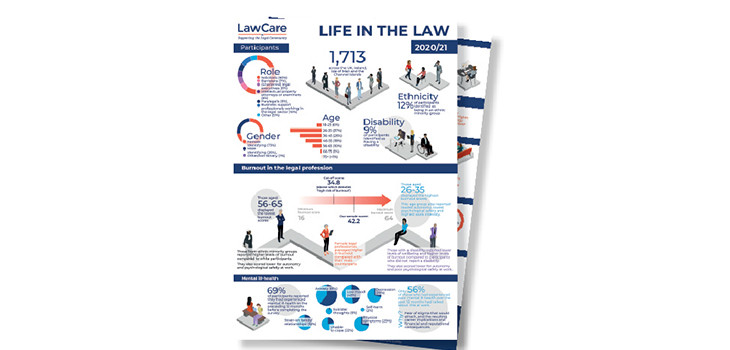
In September we released the findings of our research study, Life in the Law. This research into wellbeing questioned participants on work intensity (workload and working hours), and used three recognised scales for burnout (disengagement and exhaustion), autonomy (ability to control what, where, how, and with whom, work is done) and psychological safety (ability to speak up with ideas and questions, and raise concerns or admit mistakes). Over 1,700 professionals, including barristers and equivalents, clerks and chambers staff, from the UK, Republic of Ireland, Jersey, Guernsey, and Isle of Man took part.
The results found that legal professionals are working long hours, not getting enough sleep, and are at a high risk of burnout, with 69% sharing that they had experienced mental ill-health including stress, anxiety, and depression in the 12 months before completing the survey. Certain groups in the profession such as younger professionals, women, those from ethnic minority groups, and those with a disability present a greater risk of burnout. Of those experiencing mental ill-health, only 56% had talked about it at work – the most common reason for this was fear of stigma.
One clerk told us: ‘I have often deliberately not discussed feelings of low mood or anxiety with work colleagues and in particular barristers or line managers for fear of it having a negative impact on my future career development or others perceiving me as weak willed or sensitive.’ Others agreed that the Bar can be ‘a toxic place to work’, and that ‘those in the legal profession are more critical of mental health issues’.
Barristers talked about their difficulties in managing work/life balance during the pandemic, and while working practices ‘leapt forward 10 years in 10 weeks’, ‘working from home every day means that you are even more susceptible to being available 24/7 to clients. It makes “switching off” much more difficult, and the lines between home life and work are extremely blurred.’
The figures above made bleak reading, but the aim of Life in the Law was to look at what positive changes we could all make which could make a difference to individual wellbeing, and to the wellbeing of the profession as a whole. As one barrister told us, ‘we all have a role to play, it cannot just come from individuals’.
The overriding theme was that to have a happier life in the law we all need to work together to make all our legal workplaces, whether that’s chambers, court or inhouse, psychologically safe – an environment where people can talk openly, and feel supported.
One barrister told us: ‘Expressing frustrations with cases and having people give advice or simply listen and empathise is invaluable. Hearing other people’s problems (anonymously) can take your mind off your own problems and make you feel less alone, even though you haven’t solved your own issues.’
We want this research to be the start of a radical culture change in the law that will bring us all together to prioritise the wellbeing and the sustainability of the profession. Perhaps you can take one small step today to help make this happen? Think about how you interact with colleagues and provide that listening ear when it’s needed. If you manage others, get the support and time to do it well. Respect people’s boundaries, and value people for who they are.
Sources of help include: www.wellbeingatthebar.org.uk; www.lawcare.org.uk; and www.samaritans.org (tel: 116 123)

Elizabeth Rimmer is Chief Executive of LawCare. She started her career as a solicitor specialising in clinical negligence. Elizabeth has been managing and developing mental health charities for over 15 years, and joined LawCare in 2014.
In September we released the findings of our research study, Life in the Law. This research into wellbeing questioned participants on work intensity (workload and working hours), and used three recognised scales for burnout (disengagement and exhaustion), autonomy (ability to control what, where, how, and with whom, work is done) and psychological safety (ability to speak up with ideas and questions, and raise concerns or admit mistakes). Over 1,700 professionals, including barristers and equivalents, clerks and chambers staff, from the UK, Republic of Ireland, Jersey, Guernsey, and Isle of Man took part.
The results found that legal professionals are working long hours, not getting enough sleep, and are at a high risk of burnout, with 69% sharing that they had experienced mental ill-health including stress, anxiety, and depression in the 12 months before completing the survey. Certain groups in the profession such as younger professionals, women, those from ethnic minority groups, and those with a disability present a greater risk of burnout. Of those experiencing mental ill-health, only 56% had talked about it at work – the most common reason for this was fear of stigma.
One clerk told us: ‘I have often deliberately not discussed feelings of low mood or anxiety with work colleagues and in particular barristers or line managers for fear of it having a negative impact on my future career development or others perceiving me as weak willed or sensitive.’ Others agreed that the Bar can be ‘a toxic place to work’, and that ‘those in the legal profession are more critical of mental health issues’.
Barristers talked about their difficulties in managing work/life balance during the pandemic, and while working practices ‘leapt forward 10 years in 10 weeks’, ‘working from home every day means that you are even more susceptible to being available 24/7 to clients. It makes “switching off” much more difficult, and the lines between home life and work are extremely blurred.’
The figures above made bleak reading, but the aim of Life in the Law was to look at what positive changes we could all make which could make a difference to individual wellbeing, and to the wellbeing of the profession as a whole. As one barrister told us, ‘we all have a role to play, it cannot just come from individuals’.
The overriding theme was that to have a happier life in the law we all need to work together to make all our legal workplaces, whether that’s chambers, court or inhouse, psychologically safe – an environment where people can talk openly, and feel supported.
One barrister told us: ‘Expressing frustrations with cases and having people give advice or simply listen and empathise is invaluable. Hearing other people’s problems (anonymously) can take your mind off your own problems and make you feel less alone, even though you haven’t solved your own issues.’
We want this research to be the start of a radical culture change in the law that will bring us all together to prioritise the wellbeing and the sustainability of the profession. Perhaps you can take one small step today to help make this happen? Think about how you interact with colleagues and provide that listening ear when it’s needed. If you manage others, get the support and time to do it well. Respect people’s boundaries, and value people for who they are.
Sources of help include: www.wellbeingatthebar.org.uk; www.lawcare.org.uk; and www.samaritans.org (tel: 116 123)


Chair of the Bar finds common ground on legal services between our two jurisdictions, plus an update on jury trials
A £500 donation from AlphaBiolabs has been made to the leading UK charity tackling international parental child abduction and the movement of children across international borders
Marie Law, Director of Toxicology at AlphaBiolabs, outlines the drug and alcohol testing options available for family law professionals, and how a new, free guide can help identify the most appropriate testing method for each specific case
By Louise Crush of Westgate Wealth Management
Marie Law, Director of Toxicology at AlphaBiolabs, examines the latest ONS data on drug misuse and its implications for toxicology testing in family law cases
An interview with Rob Wagg, CEO of New Park Court Chambers
With at least 31 reports of AI hallucinations in UK legal cases – over 800 worldwide – and judges using AI to assist in judicial decision-making, the risks and benefits are impossible to ignore. Matthew Lee examines how different jurisdictions are responding
What has changed, and why? Paul Secher unpacks the new standards aligning the recruiting, training and appraising of judges – the first major change to the system for ten years
The deprivation of liberty is the most significant power the state can exercise. Drawing on frontline experience, Chris Henley KC explains why replacing trial by jury with judge-only trials risks undermining justice
Ever wondered what a pupillage is like at the CPS? This Q and A provides an insight into the training, experience and next steps
The appointments of 96 new King’s Counsel (also known as silk) are announced today