*/
MORE than 50 bar association leaders from around the world have approved a communiqué in support of access to justice. The members of the group, which gathered in London on the occasion of the opening of the legal year, have voiced their concerns about cutbacks in funding legal services at the very time when recession has highlighted the need for access to legal advice and representation, especially for the weak and vulnerable. The bar leaders agreed:
The bar leaders agreed their communiqué after participating in a seminar at the Law Society on Wednesday 30 September, which was addressed by the new Master of the Rolls, Lord Neuberger of Abbotsbury. The seminar, jointly chaired by Bob Heslett, the President of the Law Society, and Desmond Browne QC, the Chairman of the Bar, provided a forum for exchanging ideas about access to justice. 2009 marks the 60th anniversary year of the Legal Aid and Assistance Act 1949, which established the legal aid system in England and Wales. The communiqué recognises the huge contribution which this system has made, across many jurisdictions, to the welfare of citizens. It emphasises that the mounting pressure on legal aid budgets must not be allowed to affect access to justice. Cuts to legal aid which reduce access to early, specialist advice can result in spiralling legal and social problems, which ultimately require far greater expenditure of public money to resolve. The communiqué details the way in which the rule of law depends on access to justice, which is only made possible by consistent public education about legal rights and liabilities. The rule of law is both a domestic priority and an international one, underpinned by international human rights law which emphasises equality before the law and the right to a fair and impartial hearing in both criminal and civil matters. Commenting on the seminar, Desmond Browne QC, the Chairman of the Bar, said:
‘It is tragic that, on the 60th anniversary of the establishment of the legal aid system in England and Wales, the legal aid budget is being squeezed with so little thought for the grave consequences for the socially vulnerable. I am pleased to support the communiqué, which clearly elaborates the need for Governments around the world to prioritise an aspect of welfare which is just as important as health or social insurance.’
Bob Heslett, President of the Law Society, added:
‘This communiqué demonstrates the depth of feeling about access to justice felt by all those who attended today’s seminar. Access to justice, and effective legal aid systems, are hallmarks of societies governed by the rule of law. They are part of a mature society which values its citizens, and are just as important as healthcare and pension provisions. The erosion of access to justice in England and Wales, to which this Government is contributing, will have a huge impact on those who most need the support which specialist lawyers can supply. We must continue the process begun today to halt the slide toward a society where a two-tier legal system is the norm.’
The bar leaders agreed their communiqué after participating in a seminar at the Law Society on Wednesday 30 September, which was addressed by the new Master of the Rolls, Lord Neuberger of Abbotsbury. The seminar, jointly chaired by Bob Heslett, the President of the Law Society, and Desmond Browne QC, the Chairman of the Bar, provided a forum for exchanging ideas about access to justice. 2009 marks the 60th anniversary year of the Legal Aid and Assistance Act 1949, which established the legal aid system in England and Wales. The communiqué recognises the huge contribution which this system has made, across many jurisdictions, to the welfare of citizens. It emphasises that the mounting pressure on legal aid budgets must not be allowed to affect access to justice. Cuts to legal aid which reduce access to early, specialist advice can result in spiralling legal and social problems, which ultimately require far greater expenditure of public money to resolve. The communiqué details the way in which the rule of law depends on access to justice, which is only made possible by consistent public education about legal rights and liabilities. The rule of law is both a domestic priority and an international one, underpinned by international human rights law which emphasises equality before the law and the right to a fair and impartial hearing in both criminal and civil matters. Commenting on the seminar, Desmond Browne QC, the Chairman of the Bar, said:
‘It is tragic that, on the 60th anniversary of the establishment of the legal aid system in England and Wales, the legal aid budget is being squeezed with so little thought for the grave consequences for the socially vulnerable. I am pleased to support the communiqué, which clearly elaborates the need for Governments around the world to prioritise an aspect of welfare which is just as important as health or social insurance.’
Bob Heslett, President of the Law Society, added:
‘This communiqué demonstrates the depth of feeling about access to justice felt by all those who attended today’s seminar. Access to justice, and effective legal aid systems, are hallmarks of societies governed by the rule of law. They are part of a mature society which values its citizens, and are just as important as healthcare and pension provisions. The erosion of access to justice in England and Wales, to which this Government is contributing, will have a huge impact on those who most need the support which specialist lawyers can supply. We must continue the process begun today to halt the slide toward a society where a two-tier legal system is the norm.’
MORE than 50 bar association leaders from around the world have approved a communiqué in support of access to justice. The members of the group, which gathered in London on the occasion of the opening of the legal year, have voiced their concerns about cutbacks in funding legal services at the very time when recession has highlighted the need for access to legal advice and representation, especially for the weak and vulnerable. The bar leaders agreed:
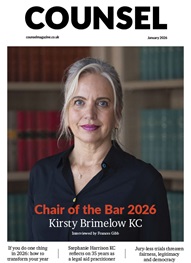

Kirsty Brimelow KC, Chair of the Bar, sets our course for 2026
What meaningful steps can you take in 2026 to advance your legal career? asks Thomas Cowan of St Pauls Chambers
Marie Law, Director of Toxicology at AlphaBiolabs, explains why drugs may appear in test results, despite the donor denying use of them
Asks Louise Crush of Westgate Wealth Management
AlphaBiolabs has donated £500 to The Christie Charity through its Giving Back initiative, helping to support cancer care, treatment and research across Greater Manchester, Cheshire and further afield
Q and A with criminal barrister Nick Murphy, who moved to New Park Court Chambers on the North Eastern Circuit in search of a better work-life balance
The appointments of 96 new King’s Counsel (also known as silk) are announced today
With pupillage application season under way, Laura Wright reflects on her route to ‘tech barrister’ and offers advice for those aiming at a career at the Bar
Jury-less trial proposals threaten fairness, legitimacy and democracy without ending the backlog, writes Professor Cheryl Thomas KC (Hon), the UK’s leading expert on juries, judges and courts
Are you ready for the new way to do tax returns? David Southern KC explains the biggest change since HMRC launched self-assessment more than 30 years ago... and its impact on the Bar
Marking one year since a Bar disciplinary tribunal dismissed all charges against her, Dr Charlotte Proudman discusses the experience, her formative years and next steps. Interview by Anthony Inglese CB