*/

© Getty Images
Kindness Ambassadors – coming to a courtroom near you! Valerie Charbit, Nicola Shannon KC and Professor Robin Banerjee update readers on the second phase of the project examining, and promoting, the impact of kindness and how it can fit into an adversarial system
'Kindness at the Bar’, a project analysing patterns of kindness among barristers, the influence of rules of conduct and impact of poor working conditions, launched in 2022. Drawing on focus‑group responses from barristers, the initial report by Professor Robin Banerjee and researchers at the University of Sussex explored experiences of kindness and the impact on working lives. It was an excellent first step, but it was clear that more could be achieved with a larger number of groups and a wider scope – not only across the Bar but also encompassing higher court advocates and the judiciary.
In 2024, when these broader focus groups met, both the Bar and our courts had changed beyond recognition. Remote hearings were a daily occurrence and there was greater pressure than ever from backlogs, client expectations and tight budgets. We suspected that kindness would be even more important in meeting those challenges.
The findings were released at an event on 11 September 2025 held at Red Lion Chambers – a co-sponsor with the South Eastern Circuit of the research. Again, we were pleased to ask Professor Robin Banerjee to present the results of his team’s research, which underscored the importance of kindness in the workplace and highlighted the significant positive impact it can have. No surprise there, you may think, but how can it fit into an adversarial system, without virtue-signaling or grandstanding?
The answer came from the lively discussion which followed. As a result, Kindness Ambassadors will hopefully be coming soon to a court near you: a group of people who have volunteered to promote kindness and encourage us all to do so as much as we possibly can. To qualify, they didn’t have to pass a test or prove they were a kind person. They simply had to commit to making an effort to be kind to others as they go about their work. By recruiting Kindness Ambassadors, we hope to generate a wave of kindness which, frankly, we all could use in an already stressful and demanding job. As one participant in the research said:
‘I think that once people are feeling a strain… kindness is one of the first commodities to go, and actually it's the most underrated commodity’ (Junior, 2, M)
Crucially, this second phase of research involved the judiciary, with the blessing of the Lady Chief Justice who permitted us to engage judges from all different jurisdictions and facilitated by HHJ Katherine Tucker.
At the South Eastern Circuit dinner on 3 October 2025, which was held shortly after the research was launched, we were delighted to hear the Lady Chief Justice place kindness at the heart of her speech that evening. It was just what was needed to reinforce that above all else, kindness needs to shine through, even when the mainstream news more broadly is painfully grim.
Professor Banerjee, along with his research team, has been instrumental in supporting, guiding and analysing the research which is the first to examine the impact of kindness on barristers, higher court advocates and judges. It explored how participants conceptualised kindness, its relational effects and the barriers to embedding it more widely. The research also considered how kindness can be better promoted in the future.
Based on five sessions with advocates and judges, the report makes clear that kindness is something everyone can practise – and that it benefits not only those who receive it but also those who show it. Kindness strengthens relationships, boosts wellbeing and may even contribute to better outcomes not only for your case but also to those around you by strengthening trust and demonstrating humanity.
‘… [My leader] rang me up and said, “What's your children's bedtime?... Tell me what time doesn't suit you for me to make phone calls to you. We'll work with that.” And I was so impressed and so appreciative of somebody recognising that I might have some boundaries now and expressing to me that he had some too. So that was a huge act of kindness’ (Silk, 6, F)
The research also highlighted the importance of recognising that being kind to others begins with being kind to yourself.
‘I call it the oxygen mask rule... Because if you look after your own welfare, you have adequate time to do your work, you will not be unnecessarily stressed and then you're more likely to be well disposed, to have the mental space and time to be kind to others…’ (Judge, 8, F)
Examples included barristers putting their clients first while minimising the impact on their opponent:
‘If the night before a case they want to rely on a new authority and it's a long one, they'll send the authority to you, but they won't just dump it on your e-mail box; they'll tell you which paragraphs of the authority they want to rely on’ (Silk, 4, M)
The research also showed that being kind feels good, and that kindness often stems from simply recognising that everyone is human and brings their own personal challenges to work:
‘I felt like I had taken the opportunity not to squash them, which has sometimes been tempting to do to be honest. But to have dealt with them nicely, … it made me feel better as a result’ (Judge, 4, F)
‘I had an opponent … who was immediately very bullish with me, saying “what's your fellow going to plead to?” and was just quite cross and angry… I came back with a croissant and a coffee and said, … “Let's just have a chat.” And it disarmed him a little bit. And then over the case, he started telling me about things that were going on for him personally and which clearly had been feeding into what I was presented with at the very outset…’ (Senior Junior, 5, F)
Some of us, on some days, are better at leaving those personal difficulties at home, but at times we are all affected by them, whether we intend to be or not. Kindness is about truly seeing and hearing the person in front of you:
‘If your opponent is kind, you're sort of in it slightly together. Yes, you've got opposing positions, but it makes a big difference. And for me it's the people who have the emotional intelligence to tell the difference between the fact that I disagree with your position, but I still care how your grandma is because the last time I saw you, you said she wasn't well. And you can hold those two things simultaneously, because we're all complex humans’ (Junior, 5, M)
‘My opponent actually noted [it] in his diary and then sent me an e-mail about it, must have been like four or five months later saying, “I hope that this week goes really smoothly for you.” And that was so moving’ (Junior, 5, M)
‘I was the prosecution Junior on a murder… This barrister, who's a Silk, pulled me to one side and said: “Slow down. You belong here. You know, you have every right to ask these questions as the rest of us. Own it”. And it was his own client I was about to cross-examine. And the next day and a half I was a different advocate, and it massively improved my performance, having somebody take a couple of seconds out to encourage me’ (Senior Junior, 2, M)
Participants also spoke about the vulnerability of junior members of the profession; examples which will resonate with anyone who has appeared in court included the importance of sharing experiences and supporting an advocate who is struggling ‘on their feet’.
‘I've had in front of me people who are very new…So sometimes it's the first time they're on their feet, and they might make errors and suggest the wrong things. And I think it's really important to be very careful not to call them out and make them look like idiots, which it sometimes could be tempting to do if you're trying to rush through…’ (Judge, 4, F)
The research also highlighted the importance of recognising the contribution of all court staff, underscoring that kindness in the workplace extends to everyone involved in the justice system.
So how did these themes compare to those from the first report? In our previous article in Counsel magazine, we highlighted that in order to achieve a culture change and to promote kindness at the Bar, we could not simply rely on creating a new policy, charter or guidance document. Co-production was the best way forward to achieve a transformation of the Bar environment.
What became clear in this second phase of the project was that while the themes remained the same, the climate had shifted. The research launch came just a few days after the publication of the Harman Report, the Independent Review into Bullying and Harassment at the Bar. While the Harman Report spoke about the many difficulties experienced in the profession, our research, by contrast, highlighted the strong collegiality within the profession and the importance of kindness in fostering collaborative teamwork and mutually supportive working relationships. None of this diminishes our professional standing in an adversarial system. As Jacinda Ardern discusses in her book A Different Kind of Power, there is another model of leadership – one in which kindness is a strength and a powerful form of influence.
Our research shows that kindness builds resilience, trust and better communication – all essential tools in the workplace. Participants noted that these qualities not only support their professional development but also make the working day more enjoyable:
‘I went to X yesterday and in the … robing room these little vases with kind of plastic flowers had suddenly appeared from nowhere … And there was a kettle. And there's some little paper cups and somebody's put some National Geographic... What a nice thing to do... It's just a little something that makes you feel that little bit more valued…’ (Senior Junior, 5, F)
So, we embark on seeking out Kindness Ambassadors who are willing to promote kindness in their workplaces. We don’t expect perfection but rather a willingness to lead by example, modelling what they hope to see and being willing to ‘re-set’ when they don’t get it right.
All five Circuit Leaders, together with the incoming and outgoing Chairs of the Criminal Bar Association, put their names to our report’s foreword emphasising that:
‘the cultivation of kindness is not about promoting softness or weakness, but is quite the opposite. It lies at the very heart of our professional success. It remains for us, and particularly for those of us in positions of influence and leadership, to heed the words of our colleagues in this report, and translate these mechanisms into practice in order to safeguard the wellbeing of all who work at the Bar.’
The willingness of so many leaders to support this project is, we hope, testament to our shared belief that kindness must be part of the culture if we are to retain the many hard‑working, high‑achieving professionals the Bar has already nurtured.
Kindness isn’t new for us at the Bar, but we need to remind ourselves of its importance in our professional lives. Making sure that it has greater impact is, for the legal profession, an inexpensive and effective way to encourage ethical behaviour and underpin the reputation of our profession.
The good news is that we at the Bar of England and Wales are not alone. After our last article was published, we were asked whether it could be republished in Australia. Since then, we have been contacted by the ‘Kind Lawyers’ network in Australia, with whom we met virtually in the New Year. If our project has reached lawyers on the other side of the world who are actively promoting it, then perhaps we have further proof of a growing global movement to support justice and humanity through kindness.
Please contact Valerie Charbit at vc@18rlc.co.uk if you would like to volunteer to be a Kindness Ambassador.
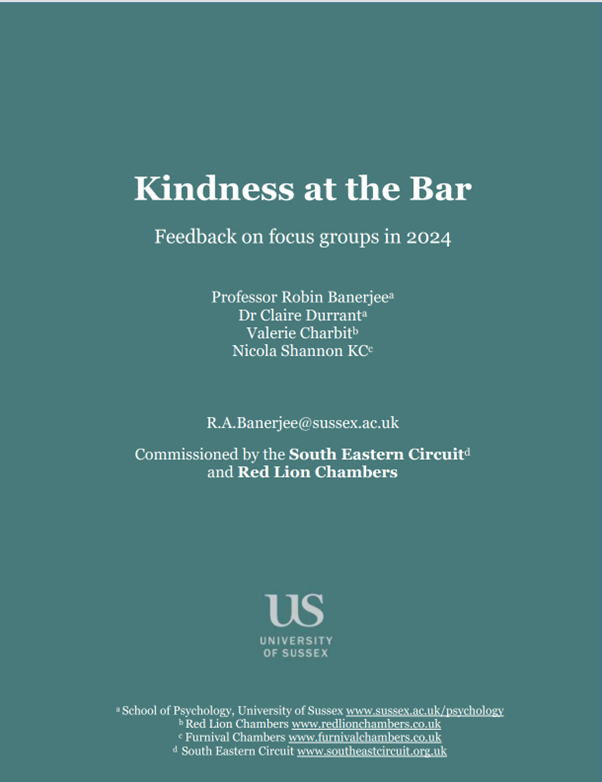
Kindness at the Bar: Feedback on focus groups in 2024, by Professor Robin Banerjee, Dr Claire Durrant, Valerie Charbit and Nicola Shannon KC, was published on 11 September 2025. The research was commissioned by the South Eastern Circuit and Red Lion Chambers, following phase one of the project commissioned by the Bar Council’s Working Group on Wellbeing at the Bar.

Valerie Charbit is a barrister and Wellbeing Director for Red Lion Chambers and has represented the Criminal Bar Association as Wellbeing Director and the South Eastern Circuit on wellbeing. She was a member of the Bar Council’s working party group on the subject and is Project Coordinator of Kindness at the Bar.

Nicola Shannon KC practises in crime and regulatory from Furnival Chambers. She is Wellbeing Director of the South Eastern Circuit, sits as a Recorder and is a board member at UK Anti-Doping.
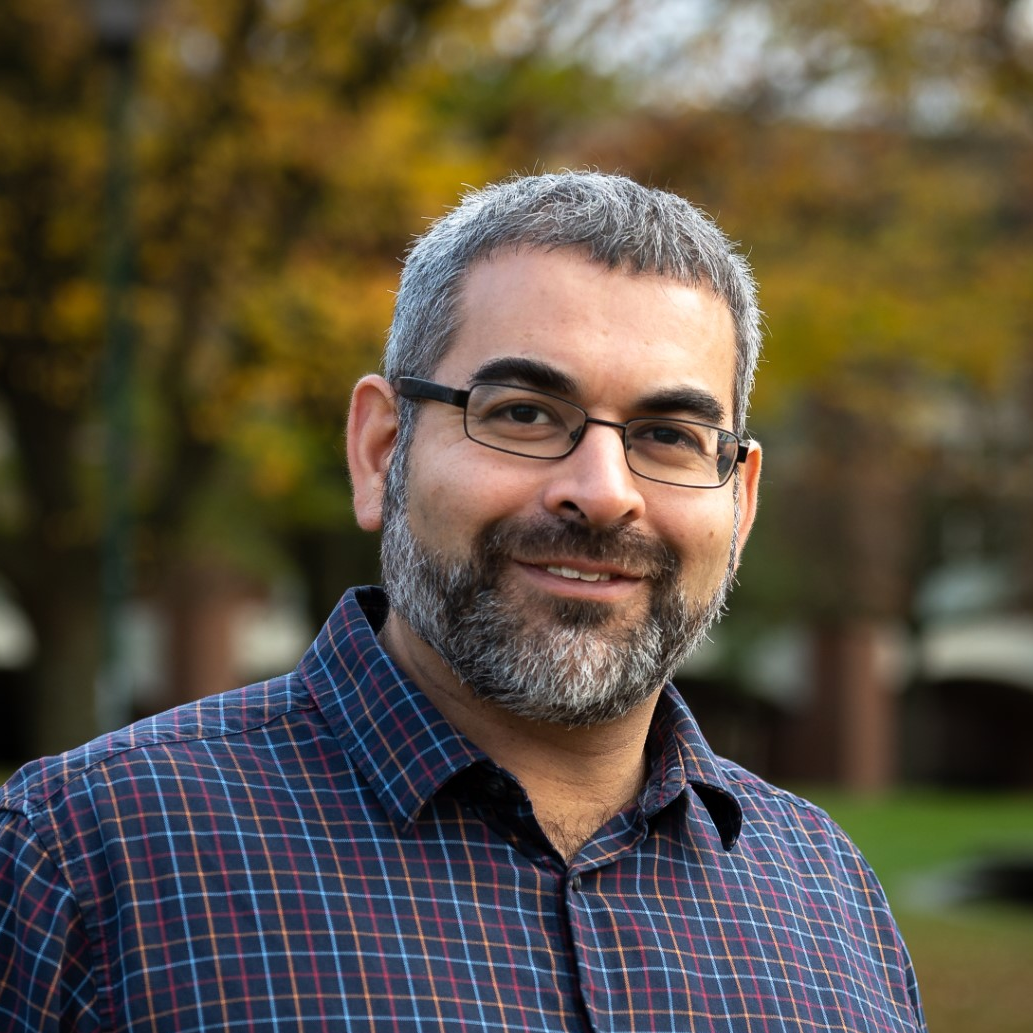
Professor Robin Banerjee is a developmental psychologist and Pro-Vice-Chancellor at the University of Sussex. He founded the Sussex Centre for Research on Kindness and recently led The Kindness Test, a major research partnership with the BBC.
'Kindness at the Bar’, a project analysing patterns of kindness among barristers, the influence of rules of conduct and impact of poor working conditions, launched in 2022. Drawing on focus‑group responses from barristers, the initial report by Professor Robin Banerjee and researchers at the University of Sussex explored experiences of kindness and the impact on working lives. It was an excellent first step, but it was clear that more could be achieved with a larger number of groups and a wider scope – not only across the Bar but also encompassing higher court advocates and the judiciary.
In 2024, when these broader focus groups met, both the Bar and our courts had changed beyond recognition. Remote hearings were a daily occurrence and there was greater pressure than ever from backlogs, client expectations and tight budgets. We suspected that kindness would be even more important in meeting those challenges.
The findings were released at an event on 11 September 2025 held at Red Lion Chambers – a co-sponsor with the South Eastern Circuit of the research. Again, we were pleased to ask Professor Robin Banerjee to present the results of his team’s research, which underscored the importance of kindness in the workplace and highlighted the significant positive impact it can have. No surprise there, you may think, but how can it fit into an adversarial system, without virtue-signaling or grandstanding?
The answer came from the lively discussion which followed. As a result, Kindness Ambassadors will hopefully be coming soon to a court near you: a group of people who have volunteered to promote kindness and encourage us all to do so as much as we possibly can. To qualify, they didn’t have to pass a test or prove they were a kind person. They simply had to commit to making an effort to be kind to others as they go about their work. By recruiting Kindness Ambassadors, we hope to generate a wave of kindness which, frankly, we all could use in an already stressful and demanding job. As one participant in the research said:
‘I think that once people are feeling a strain… kindness is one of the first commodities to go, and actually it's the most underrated commodity’ (Junior, 2, M)
Crucially, this second phase of research involved the judiciary, with the blessing of the Lady Chief Justice who permitted us to engage judges from all different jurisdictions and facilitated by HHJ Katherine Tucker.
At the South Eastern Circuit dinner on 3 October 2025, which was held shortly after the research was launched, we were delighted to hear the Lady Chief Justice place kindness at the heart of her speech that evening. It was just what was needed to reinforce that above all else, kindness needs to shine through, even when the mainstream news more broadly is painfully grim.
Professor Banerjee, along with his research team, has been instrumental in supporting, guiding and analysing the research which is the first to examine the impact of kindness on barristers, higher court advocates and judges. It explored how participants conceptualised kindness, its relational effects and the barriers to embedding it more widely. The research also considered how kindness can be better promoted in the future.
Based on five sessions with advocates and judges, the report makes clear that kindness is something everyone can practise – and that it benefits not only those who receive it but also those who show it. Kindness strengthens relationships, boosts wellbeing and may even contribute to better outcomes not only for your case but also to those around you by strengthening trust and demonstrating humanity.
‘… [My leader] rang me up and said, “What's your children's bedtime?... Tell me what time doesn't suit you for me to make phone calls to you. We'll work with that.” And I was so impressed and so appreciative of somebody recognising that I might have some boundaries now and expressing to me that he had some too. So that was a huge act of kindness’ (Silk, 6, F)
The research also highlighted the importance of recognising that being kind to others begins with being kind to yourself.
‘I call it the oxygen mask rule... Because if you look after your own welfare, you have adequate time to do your work, you will not be unnecessarily stressed and then you're more likely to be well disposed, to have the mental space and time to be kind to others…’ (Judge, 8, F)
Examples included barristers putting their clients first while minimising the impact on their opponent:
‘If the night before a case they want to rely on a new authority and it's a long one, they'll send the authority to you, but they won't just dump it on your e-mail box; they'll tell you which paragraphs of the authority they want to rely on’ (Silk, 4, M)
The research also showed that being kind feels good, and that kindness often stems from simply recognising that everyone is human and brings their own personal challenges to work:
‘I felt like I had taken the opportunity not to squash them, which has sometimes been tempting to do to be honest. But to have dealt with them nicely, … it made me feel better as a result’ (Judge, 4, F)
‘I had an opponent … who was immediately very bullish with me, saying “what's your fellow going to plead to?” and was just quite cross and angry… I came back with a croissant and a coffee and said, … “Let's just have a chat.” And it disarmed him a little bit. And then over the case, he started telling me about things that were going on for him personally and which clearly had been feeding into what I was presented with at the very outset…’ (Senior Junior, 5, F)
Some of us, on some days, are better at leaving those personal difficulties at home, but at times we are all affected by them, whether we intend to be or not. Kindness is about truly seeing and hearing the person in front of you:
‘If your opponent is kind, you're sort of in it slightly together. Yes, you've got opposing positions, but it makes a big difference. And for me it's the people who have the emotional intelligence to tell the difference between the fact that I disagree with your position, but I still care how your grandma is because the last time I saw you, you said she wasn't well. And you can hold those two things simultaneously, because we're all complex humans’ (Junior, 5, M)
‘My opponent actually noted [it] in his diary and then sent me an e-mail about it, must have been like four or five months later saying, “I hope that this week goes really smoothly for you.” And that was so moving’ (Junior, 5, M)
‘I was the prosecution Junior on a murder… This barrister, who's a Silk, pulled me to one side and said: “Slow down. You belong here. You know, you have every right to ask these questions as the rest of us. Own it”. And it was his own client I was about to cross-examine. And the next day and a half I was a different advocate, and it massively improved my performance, having somebody take a couple of seconds out to encourage me’ (Senior Junior, 2, M)
Participants also spoke about the vulnerability of junior members of the profession; examples which will resonate with anyone who has appeared in court included the importance of sharing experiences and supporting an advocate who is struggling ‘on their feet’.
‘I've had in front of me people who are very new…So sometimes it's the first time they're on their feet, and they might make errors and suggest the wrong things. And I think it's really important to be very careful not to call them out and make them look like idiots, which it sometimes could be tempting to do if you're trying to rush through…’ (Judge, 4, F)
The research also highlighted the importance of recognising the contribution of all court staff, underscoring that kindness in the workplace extends to everyone involved in the justice system.
So how did these themes compare to those from the first report? In our previous article in Counsel magazine, we highlighted that in order to achieve a culture change and to promote kindness at the Bar, we could not simply rely on creating a new policy, charter or guidance document. Co-production was the best way forward to achieve a transformation of the Bar environment.
What became clear in this second phase of the project was that while the themes remained the same, the climate had shifted. The research launch came just a few days after the publication of the Harman Report, the Independent Review into Bullying and Harassment at the Bar. While the Harman Report spoke about the many difficulties experienced in the profession, our research, by contrast, highlighted the strong collegiality within the profession and the importance of kindness in fostering collaborative teamwork and mutually supportive working relationships. None of this diminishes our professional standing in an adversarial system. As Jacinda Ardern discusses in her book A Different Kind of Power, there is another model of leadership – one in which kindness is a strength and a powerful form of influence.
Our research shows that kindness builds resilience, trust and better communication – all essential tools in the workplace. Participants noted that these qualities not only support their professional development but also make the working day more enjoyable:
‘I went to X yesterday and in the … robing room these little vases with kind of plastic flowers had suddenly appeared from nowhere … And there was a kettle. And there's some little paper cups and somebody's put some National Geographic... What a nice thing to do... It's just a little something that makes you feel that little bit more valued…’ (Senior Junior, 5, F)
So, we embark on seeking out Kindness Ambassadors who are willing to promote kindness in their workplaces. We don’t expect perfection but rather a willingness to lead by example, modelling what they hope to see and being willing to ‘re-set’ when they don’t get it right.
All five Circuit Leaders, together with the incoming and outgoing Chairs of the Criminal Bar Association, put their names to our report’s foreword emphasising that:
‘the cultivation of kindness is not about promoting softness or weakness, but is quite the opposite. It lies at the very heart of our professional success. It remains for us, and particularly for those of us in positions of influence and leadership, to heed the words of our colleagues in this report, and translate these mechanisms into practice in order to safeguard the wellbeing of all who work at the Bar.’
The willingness of so many leaders to support this project is, we hope, testament to our shared belief that kindness must be part of the culture if we are to retain the many hard‑working, high‑achieving professionals the Bar has already nurtured.
Kindness isn’t new for us at the Bar, but we need to remind ourselves of its importance in our professional lives. Making sure that it has greater impact is, for the legal profession, an inexpensive and effective way to encourage ethical behaviour and underpin the reputation of our profession.
The good news is that we at the Bar of England and Wales are not alone. After our last article was published, we were asked whether it could be republished in Australia. Since then, we have been contacted by the ‘Kind Lawyers’ network in Australia, with whom we met virtually in the New Year. If our project has reached lawyers on the other side of the world who are actively promoting it, then perhaps we have further proof of a growing global movement to support justice and humanity through kindness.
Please contact Valerie Charbit at vc@18rlc.co.uk if you would like to volunteer to be a Kindness Ambassador.
Kindness at the Bar: Feedback on focus groups in 2024, by Professor Robin Banerjee, Dr Claire Durrant, Valerie Charbit and Nicola Shannon KC, was published on 11 September 2025. The research was commissioned by the South Eastern Circuit and Red Lion Chambers, following phase one of the project commissioned by the Bar Council’s Working Group on Wellbeing at the Bar.
Kindness Ambassadors – coming to a courtroom near you! Valerie Charbit, Nicola Shannon KC and Professor Robin Banerjee update readers on the second phase of the project examining, and promoting, the impact of kindness and how it can fit into an adversarial system


The Bar Council is ready to support a turn to the efficiencies that will make a difference
A £500 donation from AlphaBiolabs has been made to the leading UK charity tackling international parental child abduction and the movement of children across international borders
By Louise Crush of Westgate Wealth Management
Marie Law, Director of Toxicology at AlphaBiolabs, examines the latest ONS data on drug misuse and its implications for toxicology testing in family law cases
An interview with Rob Wagg, CEO of New Park Court Chambers
What meaningful steps can you take in 2026 to advance your legal career? asks Thomas Cowan of St Pauls Chambers
With at least 31 reports of AI hallucinations in UK legal cases – over 800 worldwide – and judges using AI to assist in judicial decision-making, the risks and benefits are impossible to ignore. Matthew Lee examines how different jurisdictions are responding
Ever wondered what a pupillage is like at the CPS? This Q and A provides an insight into the training, experience and next steps
The appointments of 96 new King’s Counsel (also known as silk) are announced today
Resolution of the criminal justice crisis does not lie in reheating old ideas that have been roundly rejected before, say Ed Vickers KC, Faras Baloch and Katie Bacon
With pupillage application season under way, Laura Wright reflects on her route to ‘tech barrister’ and offers advice for those aiming at a career at the Bar