*/
THE Crown Prosecution Service’s policy of taking more advocacy in-house will cost the taxpayer millions, according to an independent report.
The consultants, Europe Economics, in a report commissioned by the Bar Council, reveal that the CPS’s claim to have saved £17.1m in 2007-2008 by using in-house advocates does not stand up to proper scrutiny.
According to Europe Economics, the CPS’s calculations are flawed and do not conform to Government accounting standards – the calculations exclude much of the true costs. Europe Economics states:
“The CPS ... compare the short-run marginal costs of deploying in-house advocates with the fees of self-employed barristers. This is plainly wrong, both economically and as a basis for policy-making. Barristers’ fees necessarily include an allowance for long-run costs and fixed overheads; the CPS incur such costs too but ignore them. Such skewed comparisons will always favour CPS advocates over the self-employed Bar, and will encourage the CPS to acquire excessive numbers of advocates and excessive accommodation and overhead costs to support them.” The consultants observe: “All in all, the CPS’s approach is so profoundly flawed that it should not be relied on.”
Further deficiencies in the CPS’s analysis include:
The Bar Council and the Criminal Bar Association have today sent the report to the cross-party Commons Justice Select Committee, the Attorney General Baroness Scotland of Asthal QC, Justice Secretary the Rt Hon Jack Straw MP, and the Director of Public Prosecutions Keir Starmer QC.
Criminal Bar Association Chairman Peter Lodder QC told the Justice Select Committee on 3 February 2009 that the CPS was failing to act transparently over its claims to be making savings through the use of in-house counsel.
Peter Lodder QC commented:
“I have sent the Europe Economics report to Sir Alan Beith MP, the Chairman of the Justice Select Committee. It will provide his committee with the detailed analysis necessary for a proper evaluation of the efficacy of the CPS’s advocacy services.” Desmond Browne QC, the Chairman of the Bar, added: “To claim that taking advocacy in-house will save money without taking account of the full cost smacks of Alice in Wonderland accounting.
We have been given a variety of figures regarding the savings that the CPS claims to be making from the increased use of inhouse counsel. The one thing that they have in common is the failure to account for all the costs. Simply focusing on short term marginal cost is not enough.
The economists’ report makes clear the utter poverty of the CPS’s financial analysis and shows that, far from saving money, the increased use of in-counsel will cost taxpayers many millions.”
THE Crown Prosecution Service’s policy of taking more advocacy in-house will cost the taxpayer millions, according to an independent report.
The consultants, Europe Economics, in a report commissioned by the Bar Council, reveal that the CPS’s claim to have saved £17.1m in 2007-2008 by using in-house advocates does not stand up to proper scrutiny.
According to Europe Economics, the CPS’s calculations are flawed and do not conform to Government accounting standards – the calculations exclude much of the true costs. Europe Economics states:
“The CPS ... compare the short-run marginal costs of deploying in-house advocates with the fees of self-employed barristers. This is plainly wrong, both economically and as a basis for policy-making. Barristers’ fees necessarily include an allowance for long-run costs and fixed overheads; the CPS incur such costs too but ignore them. Such skewed comparisons will always favour CPS advocates over the self-employed Bar, and will encourage the CPS to acquire excessive numbers of advocates and excessive accommodation and overhead costs to support them.” The consultants observe: “All in all, the CPS’s approach is so profoundly flawed that it should not be relied on.”
Further deficiencies in the CPS’s analysis include:
The Bar Council and the Criminal Bar Association have today sent the report to the cross-party Commons Justice Select Committee, the Attorney General Baroness Scotland of Asthal QC, Justice Secretary the Rt Hon Jack Straw MP, and the Director of Public Prosecutions Keir Starmer QC.
Criminal Bar Association Chairman Peter Lodder QC told the Justice Select Committee on 3 February 2009 that the CPS was failing to act transparently over its claims to be making savings through the use of in-house counsel.
Peter Lodder QC commented:
“I have sent the Europe Economics report to Sir Alan Beith MP, the Chairman of the Justice Select Committee. It will provide his committee with the detailed analysis necessary for a proper evaluation of the efficacy of the CPS’s advocacy services.” Desmond Browne QC, the Chairman of the Bar, added: “To claim that taking advocacy in-house will save money without taking account of the full cost smacks of Alice in Wonderland accounting.
We have been given a variety of figures regarding the savings that the CPS claims to be making from the increased use of inhouse counsel. The one thing that they have in common is the failure to account for all the costs. Simply focusing on short term marginal cost is not enough.
The economists’ report makes clear the utter poverty of the CPS’s financial analysis and shows that, far from saving money, the increased use of in-counsel will cost taxpayers many millions.”
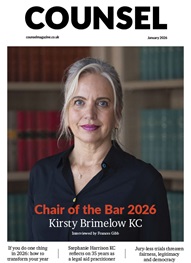

Kirsty Brimelow KC, Chair of the Bar, sets our course for 2026
What meaningful steps can you take in 2026 to advance your legal career? asks Thomas Cowan of St Pauls Chambers
Marie Law, Director of Toxicology at AlphaBiolabs, explains why drugs may appear in test results, despite the donor denying use of them
Asks Louise Crush of Westgate Wealth Management
AlphaBiolabs has donated £500 to The Christie Charity through its Giving Back initiative, helping to support cancer care, treatment and research across Greater Manchester, Cheshire and further afield
Q and A with criminal barrister Nick Murphy, who moved to New Park Court Chambers on the North Eastern Circuit in search of a better work-life balance
The appointments of 96 new King’s Counsel (also known as silk) are announced today
With pupillage application season under way, Laura Wright reflects on her route to ‘tech barrister’ and offers advice for those aiming at a career at the Bar
Jury-less trial proposals threaten fairness, legitimacy and democracy without ending the backlog, writes Professor Cheryl Thomas KC (Hon), the UK’s leading expert on juries, judges and courts
Are you ready for the new way to do tax returns? David Southern KC explains the biggest change since HMRC launched self-assessment more than 30 years ago... and its impact on the Bar
Marking one year since a Bar disciplinary tribunal dismissed all charges against her, Dr Charlotte Proudman discusses the experience, her formative years and next steps. Interview by Anthony Inglese CB