*/
Reviewed by Robin Jackson
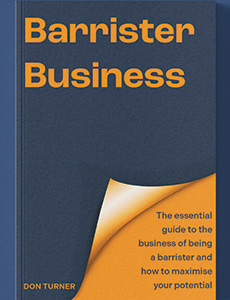
This really is a unique book, essential for barristers at any stage of their career.
Surprisingly, there seems to have been precious little written about how to manage your own business as a barrister. The Independent Bar, reviewed in Counsel magazine in July 2018, was a fine book then and is still relevant and available today. But it deals mainly with the management of chambers, not how an individual barrister, taking their first step on the ladder, can navigate the complexities of starting and developing their practice or how an established practitioner can both cope and thrive with the pressures at the self-employed Bar.
There are three short guides available from the Bar Council: the slightly outdated Building and managing your practice A-Z, which hasn’t been updated since 2018; Practice review guide for barristers and clerks published in 2023; and the 2025 edition of the Young Barristers’ Committee’s very good Starting at the Bar: your essential guide. Again, these should be read to start to understand your place within the Bar and, critically, what is expected by the regulator and your chambers, but these guides are really just for those in their early years or specifically for practice reviews.
Barrister Business, subtitled ‘The essential guide to the business of being a barrister and how to maximise your potential’, is relevant to any barrister, other than perhaps someone who has reached the very pinnacle of their career.
The author, Don Turner, is neither a barrister nor a clerk, but someone who has had considerable experience in working with and observing the workings of chambers and individual clerks and barristers. After a long a career in technical services and strategic marketing management, Turner then established a specialist business focused on the Bar and, over the last 13 years, has trained and coached hundreds of clerks and barristers and worked with many chambers on consultancy projects; I expect many of you reading this will have come across him. His previous business experience, his substantial knowledge of how the Bar operates and his own success at building a self-employed business, as well as his obviously creative, insightful and empathetic nature, combine to make this book a most valuable guide.
Because the book is aimed at all levels of practitioners, it inevitably begins with the fundamentals of starting out in practice and an explanation of how, in general, chambers operate. Already established practitioners might skim over these parts, though there are still plenty of nuggets that many a seasoned barrister could do with noting, such as financial management, wellbeing and understanding clients. However, as Turner himself points out, this is not a book you need to or should read cover to cover, but one you should dip into and out of; Turner writes, as your career progresses, ‘Keep the book nearby. It’s designed to grow with you.’ The book is very clear in its structure, and it’s written in a deliberately easy and conversational style.
Sections follow on business development, ‘how to avoid own goals’ (essential yet often overlooked) and, the concluding part, ‘It’s your move’, which gets to the nub of ‘being strategic with your personal development’. The title of the final chapter, ‘Is this the end or just the beginning? It’s over to you’, should resonate with any self-employed professional.
This book fills a notable gap. It would well serve students on the Bar training course and pupils as preparation for their future career, it should be read by all supervisors to help them guide their pupils and it would benefit almost all barristers already in practice as well as their clerks. And at £18.99 (surely tax-allowable), I really cannot think of any reason you should not buy Barrister Business.

Robin Jackson is the Civil Strategy Director at Guildhall Chambers, having worked in barristers’ chambers and as a legal-sector consultant since 2008, following other professional-services management roles and a successful public-sector career.
This really is a unique book, essential for barristers at any stage of their career.
Surprisingly, there seems to have been precious little written about how to manage your own business as a barrister. The Independent Bar, reviewed in Counsel magazine in July 2018, was a fine book then and is still relevant and available today. But it deals mainly with the management of chambers, not how an individual barrister, taking their first step on the ladder, can navigate the complexities of starting and developing their practice or how an established practitioner can both cope and thrive with the pressures at the self-employed Bar.
There are three short guides available from the Bar Council: the slightly outdated Building and managing your practice A-Z, which hasn’t been updated since 2018; Practice review guide for barristers and clerks published in 2023; and the 2025 edition of the Young Barristers’ Committee’s very good Starting at the Bar: your essential guide. Again, these should be read to start to understand your place within the Bar and, critically, what is expected by the regulator and your chambers, but these guides are really just for those in their early years or specifically for practice reviews.
Barrister Business, subtitled ‘The essential guide to the business of being a barrister and how to maximise your potential’, is relevant to any barrister, other than perhaps someone who has reached the very pinnacle of their career.
The author, Don Turner, is neither a barrister nor a clerk, but someone who has had considerable experience in working with and observing the workings of chambers and individual clerks and barristers. After a long a career in technical services and strategic marketing management, Turner then established a specialist business focused on the Bar and, over the last 13 years, has trained and coached hundreds of clerks and barristers and worked with many chambers on consultancy projects; I expect many of you reading this will have come across him. His previous business experience, his substantial knowledge of how the Bar operates and his own success at building a self-employed business, as well as his obviously creative, insightful and empathetic nature, combine to make this book a most valuable guide.
Because the book is aimed at all levels of practitioners, it inevitably begins with the fundamentals of starting out in practice and an explanation of how, in general, chambers operate. Already established practitioners might skim over these parts, though there are still plenty of nuggets that many a seasoned barrister could do with noting, such as financial management, wellbeing and understanding clients. However, as Turner himself points out, this is not a book you need to or should read cover to cover, but one you should dip into and out of; Turner writes, as your career progresses, ‘Keep the book nearby. It’s designed to grow with you.’ The book is very clear in its structure, and it’s written in a deliberately easy and conversational style.
Sections follow on business development, ‘how to avoid own goals’ (essential yet often overlooked) and, the concluding part, ‘It’s your move’, which gets to the nub of ‘being strategic with your personal development’. The title of the final chapter, ‘Is this the end or just the beginning? It’s over to you’, should resonate with any self-employed professional.
This book fills a notable gap. It would well serve students on the Bar training course and pupils as preparation for their future career, it should be read by all supervisors to help them guide their pupils and it would benefit almost all barristers already in practice as well as their clerks. And at £18.99 (surely tax-allowable), I really cannot think of any reason you should not buy Barrister Business.
Reviewed by Robin Jackson


Chair of the Bar finds common ground on legal services between our two jurisdictions, plus an update on jury trials
A £500 donation from AlphaBiolabs has been made to the leading UK charity tackling international parental child abduction and the movement of children across international borders
Marie Law, Director of Toxicology at AlphaBiolabs, outlines the drug and alcohol testing options available for family law professionals, and how a new, free guide can help identify the most appropriate testing method for each specific case
By Louise Crush of Westgate Wealth Management
Marie Law, Director of Toxicology at AlphaBiolabs, examines the latest ONS data on drug misuse and its implications for toxicology testing in family law cases
An interview with Rob Wagg, CEO of New Park Court Chambers
With at least 31 reports of AI hallucinations in UK legal cases – over 800 worldwide – and judges using AI to assist in judicial decision-making, the risks and benefits are impossible to ignore. Matthew Lee examines how different jurisdictions are responding
What has changed, and why? Paul Secher unpacks the new standards aligning the recruiting, training and appraising of judges – the first major change to the system for ten years
The deprivation of liberty is the most significant power the state can exercise. Drawing on frontline experience, Chris Henley KC explains why replacing trial by jury with judge-only trials risks undermining justice
Baffled by the government’s proposed s 41 reforms and by the Law Commission’s preferred model, Laura Hoyano looks at what won’t work, and what will
Ever wondered what a pupillage is like at the CPS? This Q and A provides an insight into the training, experience and next steps