*/
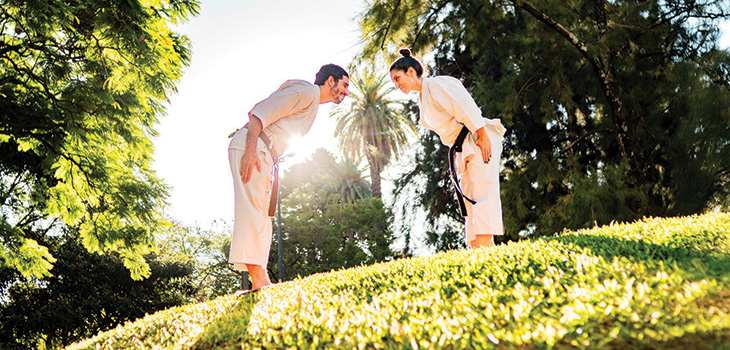
The gentle way. By David Hughes
I blame my son. And Bernard Richmond KC.
Some years ago, teaching advocacy trainers in Cardiff, Bernard Richmond mentioned the concept of kuzushi – ‘breaking balance’. My son wanted to try a combat sport, and this made me think judo might suit him – not, at that point, me. My main sporting interest was rollerskiing, at which I reached the dizzy heights of not-quite-last in the British Rollerski Series.
Judo is usually rendered in English as ‘the gentle way’. French and Spanish prefer ‘the flexible way’, whereas Italian opts for ‘the yielding way’, which to this non-Japanese speaker seems more apt. An Olympic sport and a highly effective form of self-defence, because it doesn’t involve striking, judo can practised realistically but safely. It’s also, more importantly for most of us, great fun.
I found a club, and took my son along. The senseis (coaches) and kids were friendly, he had fun, and the vibe was definitely more Miyagi-do than Cobra Kai. After a while, I thought, if you can’t beat ‘em, join ‘em. ‘If you keep it up, after the summer break, I’ll start too’ was the promise made, and a barrister’s word is their bond…
At my first session, I found myself approached by a black belt. Beginners are often paired up with dan-grades, as they are the safest partners. There was a smile that was meant to be reassuring, and off we went.
The great French judoka Teddy Riner has described judo as a dance for strong people. On that score, I’m not a natural judoka. My dancing is characterised by an absence of rhythm, and I lack confidence in physical confrontation. But it didn’t take long for me to start looking forward to classes. I wasn’t getting good, but I was getting better – and so will you.
The belt system means that there’s always something to aim for. Grading (red through to brown belts in the UK) involves learning a syllabus of throws, pins, armlocks and strangles, and demonstrating them in your club. Tori (thrower) and uke (throw-ee) cooperate – you’ll want your clubmates to get their belts. There are then two routes to the coveted black belt, competitive and technical.
Judo is a social activity – it takes two to tachi-waza. And judo people are among the very best: they’ll welcome you into their club and take care of your safety. My son, who has autism, competes in adaptive judo – and gets to see expert fighters show that that is absolutely compatible with kindness and inclusivity.
Unlike when running or cycling or rollerskiing, I don’t find my mind wandering back to work. I’ve gained in self-confidence. I’ve made the sort of friends I trust enough to put me in a strangle-hold. I’ve felt the power of the great Neil Adams (when helping my son to throw me), I’ve met Cuba’s first ever Olympic champion and become friends with a Paralympic silver medallist. I may never be a particularly good judoka, but I can be a good clubmate, who helps those around him get better, and there’s a real satisfaction in that.
Even the Japanese terminology, which can seem an obstacle at first, you’ll start to see as a gateway: it comes quickly enough and means that, if you want to take your gi on holiday, you’ll be able to join in. Wherever you may go, Hajime means ‘go’, ‘mate’ means stop, and the throws between those two have the same names too.

I blame my son. And Bernard Richmond KC.
Some years ago, teaching advocacy trainers in Cardiff, Bernard Richmond mentioned the concept of kuzushi – ‘breaking balance’. My son wanted to try a combat sport, and this made me think judo might suit him – not, at that point, me. My main sporting interest was rollerskiing, at which I reached the dizzy heights of not-quite-last in the British Rollerski Series.
Judo is usually rendered in English as ‘the gentle way’. French and Spanish prefer ‘the flexible way’, whereas Italian opts for ‘the yielding way’, which to this non-Japanese speaker seems more apt. An Olympic sport and a highly effective form of self-defence, because it doesn’t involve striking, judo can practised realistically but safely. It’s also, more importantly for most of us, great fun.
I found a club, and took my son along. The senseis (coaches) and kids were friendly, he had fun, and the vibe was definitely more Miyagi-do than Cobra Kai. After a while, I thought, if you can’t beat ‘em, join ‘em. ‘If you keep it up, after the summer break, I’ll start too’ was the promise made, and a barrister’s word is their bond…
At my first session, I found myself approached by a black belt. Beginners are often paired up with dan-grades, as they are the safest partners. There was a smile that was meant to be reassuring, and off we went.
The great French judoka Teddy Riner has described judo as a dance for strong people. On that score, I’m not a natural judoka. My dancing is characterised by an absence of rhythm, and I lack confidence in physical confrontation. But it didn’t take long for me to start looking forward to classes. I wasn’t getting good, but I was getting better – and so will you.
The belt system means that there’s always something to aim for. Grading (red through to brown belts in the UK) involves learning a syllabus of throws, pins, armlocks and strangles, and demonstrating them in your club. Tori (thrower) and uke (throw-ee) cooperate – you’ll want your clubmates to get their belts. There are then two routes to the coveted black belt, competitive and technical.
Judo is a social activity – it takes two to tachi-waza. And judo people are among the very best: they’ll welcome you into their club and take care of your safety. My son, who has autism, competes in adaptive judo – and gets to see expert fighters show that that is absolutely compatible with kindness and inclusivity.
Unlike when running or cycling or rollerskiing, I don’t find my mind wandering back to work. I’ve gained in self-confidence. I’ve made the sort of friends I trust enough to put me in a strangle-hold. I’ve felt the power of the great Neil Adams (when helping my son to throw me), I’ve met Cuba’s first ever Olympic champion and become friends with a Paralympic silver medallist. I may never be a particularly good judoka, but I can be a good clubmate, who helps those around him get better, and there’s a real satisfaction in that.
Even the Japanese terminology, which can seem an obstacle at first, you’ll start to see as a gateway: it comes quickly enough and means that, if you want to take your gi on holiday, you’ll be able to join in. Wherever you may go, Hajime means ‘go’, ‘mate’ means stop, and the throws between those two have the same names too.
The gentle way. By David Hughes


Chair of the Bar finds common ground on legal services between our two jurisdictions, plus an update on jury trials
A £500 donation from AlphaBiolabs has been made to the leading UK charity tackling international parental child abduction and the movement of children across international borders
Marie Law, Director of Toxicology at AlphaBiolabs, outlines the drug and alcohol testing options available for family law professionals, and how a new, free guide can help identify the most appropriate testing method for each specific case
By Louise Crush of Westgate Wealth Management
Marie Law, Director of Toxicology at AlphaBiolabs, examines the latest ONS data on drug misuse and its implications for toxicology testing in family law cases
An interview with Rob Wagg, CEO of New Park Court Chambers
With at least 31 reports of AI hallucinations in UK legal cases – over 800 worldwide – and judges using AI to assist in judicial decision-making, the risks and benefits are impossible to ignore. Matthew Lee examines how different jurisdictions are responding
What has changed, and why? Paul Secher unpacks the new standards aligning the recruiting, training and appraising of judges – the first major change to the system for ten years
The deprivation of liberty is the most significant power the state can exercise. Drawing on frontline experience, Chris Henley KC explains why replacing trial by jury with judge-only trials risks undermining justice
Baffled by the government’s proposed s 41 reforms and by the Law Commission’s preferred model, Laura Hoyano looks at what won’t work, and what will
Ever wondered what a pupillage is like at the CPS? This Q and A provides an insight into the training, experience and next steps