*/
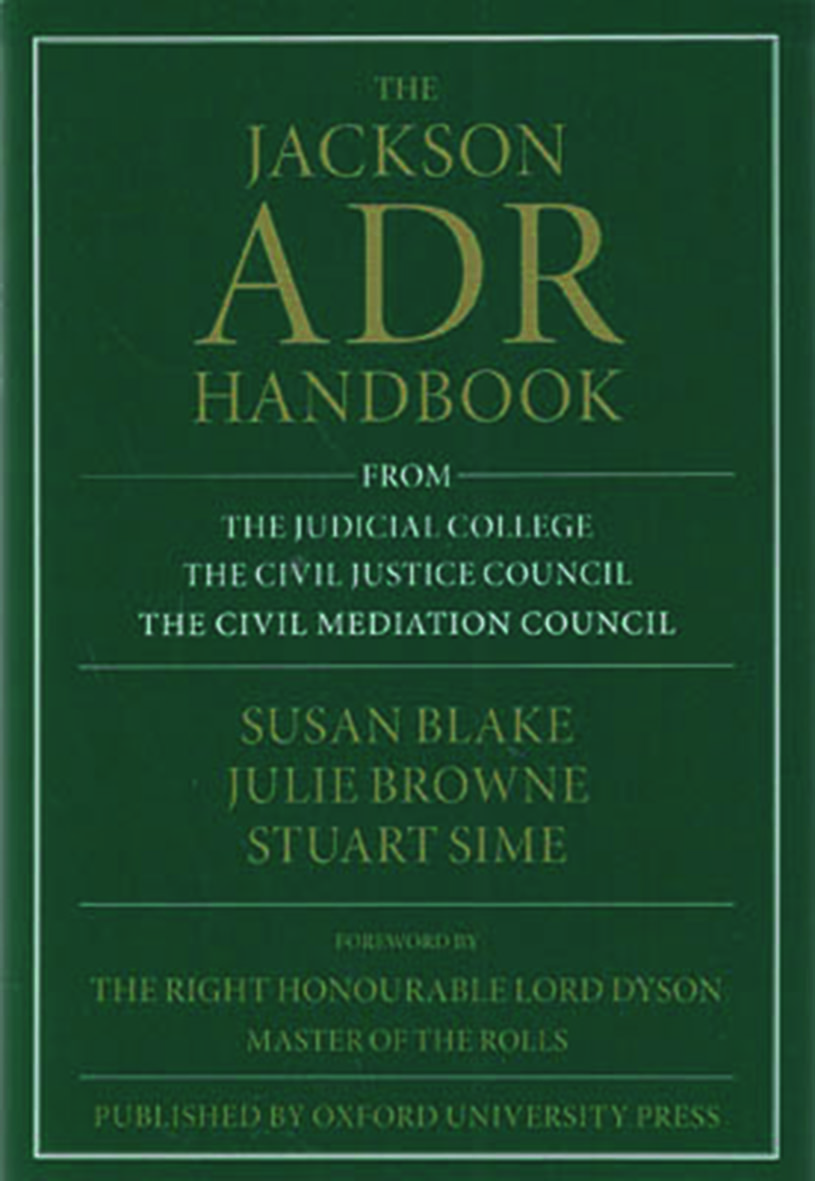 Susan Blake, Julie Browne and Stuart Sime
ISBN: 978-0-19-967646-0
25 April 2013
Paperback, 336 pages
Publisher: Oxford University Press
Price: £34.99
Also available as an eBook
The importance of this handbook to the integration of Alternative Dispute Resolution (ADR) within our civil justice system cannot be overstated. Similar ADR texts have been published in the past (most notably A Practical Approach to ADR (OUP)) by the same authors, on which elements of the current handbook are clearly based. However, no other ADR text has received such high profile endorsement - by Lord Justice Jackson, the Judicial College, the Civil Justice Council and the Civil Mediation Council.
With the assistance of an eminent Editorial Advisory Board comprising predominately judges and barristers and some practising mediators, the handbook is intended to inform litigants, lawyers and judges alike about the benefits of ADR in the hope that it will become more readily deployed in the context of civil litigation. Given the broad target audience, the book assumes little knowledge, and contains both broad overview chapters with useful ancillary information (for example on Part 36 and DBAs), as well as specialist chapters (for example on the roles and responsibilities of lawyers and parties to ADR (chapter 4), and ethics for lawyers (chapter 6)).
The handbook covers the full range of ADR processes, from negotiation (chapter 12) through to arbitration (chapter 25), as well as dedicated chapters on early neutral evaluation (chapter 22), conciliation and ombudsmen (chapter 23), expert determination (chapter 24) and adjudication (chapter 26). In depth guidance on mediation practice and procedure is contained in chapters 13-17, covering mediation within litigation,including a comprehensive review of how the courts approach ADR and what a judge can and cannot order in terms of ADR (including costs sanctions). The summary of case law is both readable and comprehensive. The reader is also taken step-by-step through how to prepare for, and what to expect at, a mediation (including flow charts). Additional materials on mediation providers, specimen documents, and text updates are all available on a supporting website (which will likely prove to be a valuable future resource). As such, the handbook covers a huge amount of material, yet is relatively short and easy to navigate. It also gives mediation (which is, rightly, the central focus of the book) context, by covering it alongside a range of other ADR processes. The book ultimately provides a user friendly end-to-end guide to ADR which is up-to-date, authoritative and comprehensive.
Lord Justice Jackson’s aim in recommending that an ADR handbook be published was to instigate “cultural change”. The success of the handbook and ADR more generally will to a great extent depend on its target audience (litigants, lawyers and judges) being made aware of the handbook and using it regularly. Ideally it should be purchased and used by practitioners alongside the White Book (which, interestingly, has for many years contained its own (oft overlooked) procedural guide to ADR in Volume 2). Given there have been no rule changes requiring parties to consider ADR either before or during litigation as a result of the Jackson reforms, publicity of the handbook, and the continuing education of litigants, lawyers and the judiciary alike, will be key.
Now more than ever, the judiciary plays an essential role in promoting ADR in appropriate cases, both within and even more importantly outside the commercial context, where litigants have less experience of ADR and may need guidance.
This is just the handbook to help them do so.
Ian Gatt QC & Anita Phillips
Herbert Smith Freehills LLP
The handbook covers the full range of ADR processes, from negotiation (chapter 12) through to arbitration (chapter 25), as well as dedicated chapters on early neutral evaluation (chapter 22), conciliation and ombudsmen (chapter 23), expert determination (chapter 24) and adjudication (chapter 26). In depth guidance on mediation practice and procedure is contained in chapters 13-17, covering mediation within litigation,including a comprehensive review of how the courts approach ADR and what a judge can and cannot order in terms of ADR (including costs sanctions). The summary of case law is both readable and comprehensive. The reader is also taken step-by-step through how to prepare for, and what to expect at, a mediation (including flow charts). Additional materials on mediation providers, specimen documents, and text updates are all available on a supporting website (which will likely prove to be a valuable future resource). As such, the handbook covers a huge amount of material, yet is relatively short and easy to navigate. It also gives mediation (which is, rightly, the central focus of the book) context, by covering it alongside a range of other ADR processes. The book ultimately provides a user friendly end-to-end guide to ADR which is up-to-date, authoritative and comprehensive.
Lord Justice Jackson’s aim in recommending that an ADR handbook be published was to instigate “cultural change”. The success of the handbook and ADR more generally will to a great extent depend on its target audience (litigants, lawyers and judges) being made aware of the handbook and using it regularly. Ideally it should be purchased and used by practitioners alongside the White Book (which, interestingly, has for many years contained its own (oft overlooked) procedural guide to ADR in Volume 2). Given there have been no rule changes requiring parties to consider ADR either before or during litigation as a result of the Jackson reforms, publicity of the handbook, and the continuing education of litigants, lawyers and the judiciary alike, will be key.
Now more than ever, the judiciary plays an essential role in promoting ADR in appropriate cases, both within and even more importantly outside the commercial context, where litigants have less experience of ADR and may need guidance.
This is just the handbook to help them do so.
Ian Gatt QC & Anita Phillips
Herbert Smith Freehills LLP
Susan Blake, Julie Browne and Stuart Sime
ISBN: 978-0-19-967646-0
25 April 2013
Paperback, 336 pages
Publisher: Oxford University Press
Price: £34.99
Also available as an eBook
The importance of this handbook to the integration of Alternative Dispute Resolution (ADR) within our civil justice system cannot be overstated. Similar ADR texts have been published in the past (most notably A Practical Approach to ADR (OUP)) by the same authors, on which elements of the current handbook are clearly based. However, no other ADR text has received such high profile endorsement - by Lord Justice Jackson, the Judicial College, the Civil Justice Council and the Civil Mediation Council.
With the assistance of an eminent Editorial Advisory Board comprising predominately judges and barristers and some practising mediators, the handbook is intended to inform litigants, lawyers and judges alike about the benefits of ADR in the hope that it will become more readily deployed in the context of civil litigation. Given the broad target audience, the book assumes little knowledge, and contains both broad overview chapters with useful ancillary information (for example on Part 36 and DBAs), as well as specialist chapters (for example on the roles and responsibilities of lawyers and parties to ADR (chapter 4), and ethics for lawyers (chapter 6)).


Chair of the Bar finds common ground on legal services between our two jurisdictions, plus an update on jury trials
A £500 donation from AlphaBiolabs has been made to the leading UK charity tackling international parental child abduction and the movement of children across international borders
Marie Law, Director of Toxicology at AlphaBiolabs, outlines the drug and alcohol testing options available for family law professionals, and how a new, free guide can help identify the most appropriate testing method for each specific case
By Louise Crush of Westgate Wealth Management
Marie Law, Director of Toxicology at AlphaBiolabs, examines the latest ONS data on drug misuse and its implications for toxicology testing in family law cases
An interview with Rob Wagg, CEO of New Park Court Chambers
With at least 31 reports of AI hallucinations in UK legal cases – over 800 worldwide – and judges using AI to assist in judicial decision-making, the risks and benefits are impossible to ignore. Matthew Lee examines how different jurisdictions are responding
What has changed, and why? Paul Secher unpacks the new standards aligning the recruiting, training and appraising of judges – the first major change to the system for ten years
The deprivation of liberty is the most significant power the state can exercise. Drawing on frontline experience, Chris Henley KC explains why replacing trial by jury with judge-only trials risks undermining justice
Ever wondered what a pupillage is like at the CPS? This Q and A provides an insight into the training, experience and next steps
The appointments of 96 new King’s Counsel (also known as silk) are announced today