*/
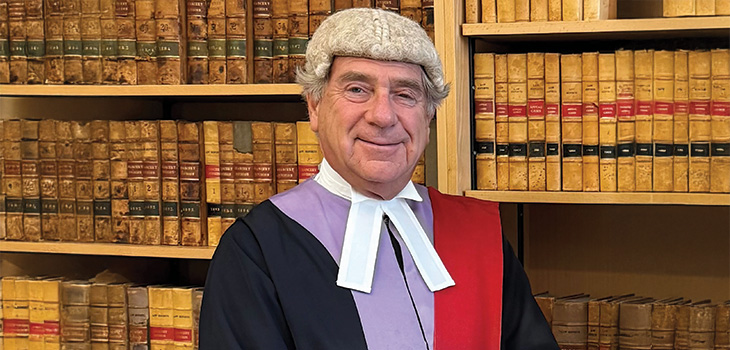
There is far more to Martyn Levett than the title of Resident Judge suggests, discovers Steven Ball. As a long-serving Honorary Recorder of Ipswich – a role that embodies the connection between civic life and the legal world – Judge Levett reflects on his community, charity work and criminal justice today
He may have recently retired as a Circuit Judge but there is little that feels ‘retiring’ or ‘recumbent’ about HH Martyn Levett. Energetic and engaging, rather than wistful or melancholic, he steps down after ten years in the full-time judiciary with eight challenging years at the helm guiding the court through COVID and navigating the continuing backlog. Called by Middle Temple in 1978, he spent 37 years at the Bar making a significant contribution in that time to the development of Red Lion Chambers – a London set with firm foundations in East Anglia.
We meet in his penultimate month as Resident Judge. Upon arrival, I am met by an usher and taken to meet Judge Levett in the main office where he is holding a different court; with a coterie of court staff, giving hands-on last-minute directions to list cases for the following day.
We repair to his judge’s chambers. The space feels lived-in with many books, papers and mementos; the walls are adorned with pictures of Suffolk. Judge Levett may be the rosy swain because, with simple joy, he recounts that Suffolk, the place he has called home for over 50 years: ‘has everything – peace, beauty and history – from land to sea’. Yet beneath this bucolic veneer, lies a harsher truth. Towns across Suffolk, like many throughout Britain, have been blighted with cocaine, cannabis and county lines. The Crown Court at Ipswich is bustling with cases. Judge Levett acknowledges that his workload had ‘stopped him noticing how sweet the world can be’.
He recently presided over the trial of a man who had murdered a lone female dog walker. The shockwaves reverberated throughout the local community and the facts were eerily similar to those of the Chillenden murders in Kent some 30 years before where the motive was difficult to establish. He references his own sentencing remarks on the impact on the local community: ‘Because the killer was unknown and unidentified for a long time and the sudden and violent nature of the murder caused residents to feel less safe in their homes and neighbourhoods. People withdrew from community activities and avoided public spaces.’
While others in his position might eagerly count down the days to retirement I detect that he is approaching the winding down of his duties with a measure of reluctance. What conductor wishes to lay down his baton when still in full flow? Refencing TS Eliot and April being the cruellest month, he remarked that for him it would be December, as that is when he will be relinquishing his post. No doubt his irrepressible spirit, unencumbered of daily case management, will continue to share his wisdom in other courtrooms of the South-East for several years to come.
It could have turned out quite differently. As a student of Leeds University it was chemical engineering that first captured his curiosity. Law came later. His Damascene moment came not on the ‘road to Headingley’ but as a post-graduate when he was faced a choice between the glitter of London and the mizzle of Glasgow. Fresh-faced and light of care, he chose the former and it was the backdrop of the Temple that triumphed over the Tenements.
In one of his earliest cases, he recalls representing a village hall burglar who was ‘bang to rights’ as his fingerprints were all over the scene. With little room for evidential manoeuvre he observed to the jury, with youthful chutzpah, that it couldn’t have been the defendant who had broken in and left 14 fingerprints: as his client, he reminded them ‘only had ten fingers!’
His entry point to the legal world came at a time far removed from the one that we know today; a time without mobile phones, the Digital Case System or Sentencing Guidelines. We may agree that these are welcome improvements but he bemoans the decline of chambers life for the Bar: ‘Without a physical presence in chambers spontaneous learning opportunities diminish,’ he says. ‘If barristers work in isolation the shared understanding of ethics, etiquette and advocacy standards risks dilution.’ He adds that ‘chambers provides emotional support and camaraderie that helps resilience’. We talk about the advantages of using CVP but he warns that ‘remote working can lead to loneliness and burnout which exacerbates barriers to entry with its long-term consequences which we are already seeing’.
Judge Levett’s solution to reducing some of the backlog is characteristic of his singular energy – by not starting cases at 10:30am, but earlier. I suggest that there was nothing novel about this idea as his court usually sits at 9:30am! At this point he purses his lips, raises his eyebrows and gives me a reassuring look. Striking a serious tone, he says: ‘You need to be careful when using data about attrition rates and backlogs to justify changes to the procedures of jury trials. Statistics can be distorted and used inappropriately.’
After all of these years he still retains a steadfast faith in the jury system: ‘By and large the jury gets it right and I have never profoundly disagreed with any verdict reached.’ Delving more deeply into the rule of law, he says that the public do have confidence in the jury system. ‘It is traditionally seen as a democratic safeguard with a cross-section of society determining guilt.’ Replacing this with judge-alone trials, he lamented, may bring ‘a reduced legitimacy’. He also feels sure that the public would latch on to opportunities to challenge judges for perceived bias with all the recusal litigation that would entail.
As for ‘the number of litigants in person who already have little confidence in the system; their perception of fairness will be skewed.’ Whether there needs to be 12 people ‘good and true’ is another matter; he comments that during ‘the War’ juries comprised only of seven. The challenge is twofold: ‘to preserve the integrity of justice while adapting to modern needs and to inspire confidence in the alternative that it would be fair and impartial.’
As keen as I am to ask him more about his insights on the criminal justice system, he is equally eager to discuss his community work – in which he takes genuine pride. He intends to remain closely connected to the County of Suffolk and its future through the Lieutenancy and his charitable work. He has volunteered with groups supporting survivors of sexual assaults, spoken to college students and raised money for armed force veterans. Judge Levett’s outreach into the lives of young people through educational initiatives stems from his desire to promote awareness of the rule of law and to promote safety for women and girls from what he called the ‘epidemic of violence’. He is acutely aware of the delayed social consequences of lockdown for young people. Knife crime and drugs, he warns ‘imperils all young people, as does the erosion of mutual respect’ and he laments the herbal and synthetic cannabis that is ‘wreaking untold damage on the mental health of young and old alike’.
I am given an impromptu tour of the back corridors where we pass portraits of past Presiders. We also meet many cleaners and security officers along the way. Each is cheerily greeted by Judge Levett using their first names and he pays tribute to ‘the loyal and skillful staff who work tirelessly to keep us safe’. Judge Levett describes the court building, opened in 2004, as ‘spatial’ and one of the modern architectural highlights of a town which, in his view, is deserving of City status.
As my time with him draws to an end, I ask him what advice he wishes he had been given by his predecessor – or would now offer to his successor. He bats both of these questions away with good humour. He says he wouldn’t have wished for anything at all, for it is better, he insists to ‘finds one’s own way on what is your own journey’.
I press him on what he would he say to junior counsel. ‘Enjoy every moment you have,’ quickly comes back his reply. He muses that ‘honesty is the greatest quality in an advocate’ and ‘quality in appearance is essential’ to maintain the public’s confidence in a barrister. In his view, the ‘art of the barrister’ is underpinned by philosophy: to enter the fray; to listen; to reason; and to refine. The goal may be not to win an argument but to be nearer to the truth. What about judges, I ask? He guides me to the Gospel according to Luke 18:1:8, ‘even an unjust judge yields to persistence’. From that I surmise that good judges listen and… even they can change their minds.
As I leave the building, the words of poet Robert Whittington come to mind – Martyn Levett is a ‘man of angel’s wit and singular learning..., a man of marvellous mirth and sometime of steadfast gravity… a man for all seasons’.
CV – HH Martyn Levett DL
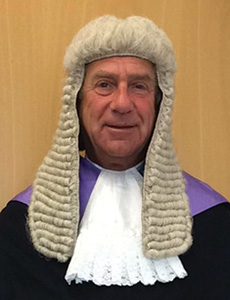
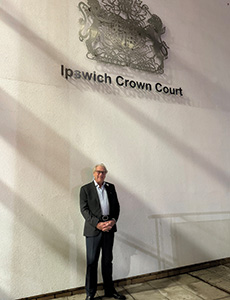

Steven Ball is a criminal practitioner at Red Lion Chambers ranked in this years’ Legal 500 and is based at their Chelmsford annexe working across East Anglia and London.
He may have recently retired as a Circuit Judge but there is little that feels ‘retiring’ or ‘recumbent’ about HH Martyn Levett. Energetic and engaging, rather than wistful or melancholic, he steps down after ten years in the full-time judiciary with eight challenging years at the helm guiding the court through COVID and navigating the continuing backlog. Called by Middle Temple in 1978, he spent 37 years at the Bar making a significant contribution in that time to the development of Red Lion Chambers – a London set with firm foundations in East Anglia.
We meet in his penultimate month as Resident Judge. Upon arrival, I am met by an usher and taken to meet Judge Levett in the main office where he is holding a different court; with a coterie of court staff, giving hands-on last-minute directions to list cases for the following day.
We repair to his judge’s chambers. The space feels lived-in with many books, papers and mementos; the walls are adorned with pictures of Suffolk. Judge Levett may be the rosy swain because, with simple joy, he recounts that Suffolk, the place he has called home for over 50 years: ‘has everything – peace, beauty and history – from land to sea’. Yet beneath this bucolic veneer, lies a harsher truth. Towns across Suffolk, like many throughout Britain, have been blighted with cocaine, cannabis and county lines. The Crown Court at Ipswich is bustling with cases. Judge Levett acknowledges that his workload had ‘stopped him noticing how sweet the world can be’.
He recently presided over the trial of a man who had murdered a lone female dog walker. The shockwaves reverberated throughout the local community and the facts were eerily similar to those of the Chillenden murders in Kent some 30 years before where the motive was difficult to establish. He references his own sentencing remarks on the impact on the local community: ‘Because the killer was unknown and unidentified for a long time and the sudden and violent nature of the murder caused residents to feel less safe in their homes and neighbourhoods. People withdrew from community activities and avoided public spaces.’
While others in his position might eagerly count down the days to retirement I detect that he is approaching the winding down of his duties with a measure of reluctance. What conductor wishes to lay down his baton when still in full flow? Refencing TS Eliot and April being the cruellest month, he remarked that for him it would be December, as that is when he will be relinquishing his post. No doubt his irrepressible spirit, unencumbered of daily case management, will continue to share his wisdom in other courtrooms of the South-East for several years to come.
It could have turned out quite differently. As a student of Leeds University it was chemical engineering that first captured his curiosity. Law came later. His Damascene moment came not on the ‘road to Headingley’ but as a post-graduate when he was faced a choice between the glitter of London and the mizzle of Glasgow. Fresh-faced and light of care, he chose the former and it was the backdrop of the Temple that triumphed over the Tenements.
In one of his earliest cases, he recalls representing a village hall burglar who was ‘bang to rights’ as his fingerprints were all over the scene. With little room for evidential manoeuvre he observed to the jury, with youthful chutzpah, that it couldn’t have been the defendant who had broken in and left 14 fingerprints: as his client, he reminded them ‘only had ten fingers!’
His entry point to the legal world came at a time far removed from the one that we know today; a time without mobile phones, the Digital Case System or Sentencing Guidelines. We may agree that these are welcome improvements but he bemoans the decline of chambers life for the Bar: ‘Without a physical presence in chambers spontaneous learning opportunities diminish,’ he says. ‘If barristers work in isolation the shared understanding of ethics, etiquette and advocacy standards risks dilution.’ He adds that ‘chambers provides emotional support and camaraderie that helps resilience’. We talk about the advantages of using CVP but he warns that ‘remote working can lead to loneliness and burnout which exacerbates barriers to entry with its long-term consequences which we are already seeing’.
Judge Levett’s solution to reducing some of the backlog is characteristic of his singular energy – by not starting cases at 10:30am, but earlier. I suggest that there was nothing novel about this idea as his court usually sits at 9:30am! At this point he purses his lips, raises his eyebrows and gives me a reassuring look. Striking a serious tone, he says: ‘You need to be careful when using data about attrition rates and backlogs to justify changes to the procedures of jury trials. Statistics can be distorted and used inappropriately.’
After all of these years he still retains a steadfast faith in the jury system: ‘By and large the jury gets it right and I have never profoundly disagreed with any verdict reached.’ Delving more deeply into the rule of law, he says that the public do have confidence in the jury system. ‘It is traditionally seen as a democratic safeguard with a cross-section of society determining guilt.’ Replacing this with judge-alone trials, he lamented, may bring ‘a reduced legitimacy’. He also feels sure that the public would latch on to opportunities to challenge judges for perceived bias with all the recusal litigation that would entail.
As for ‘the number of litigants in person who already have little confidence in the system; their perception of fairness will be skewed.’ Whether there needs to be 12 people ‘good and true’ is another matter; he comments that during ‘the War’ juries comprised only of seven. The challenge is twofold: ‘to preserve the integrity of justice while adapting to modern needs and to inspire confidence in the alternative that it would be fair and impartial.’
As keen as I am to ask him more about his insights on the criminal justice system, he is equally eager to discuss his community work – in which he takes genuine pride. He intends to remain closely connected to the County of Suffolk and its future through the Lieutenancy and his charitable work. He has volunteered with groups supporting survivors of sexual assaults, spoken to college students and raised money for armed force veterans. Judge Levett’s outreach into the lives of young people through educational initiatives stems from his desire to promote awareness of the rule of law and to promote safety for women and girls from what he called the ‘epidemic of violence’. He is acutely aware of the delayed social consequences of lockdown for young people. Knife crime and drugs, he warns ‘imperils all young people, as does the erosion of mutual respect’ and he laments the herbal and synthetic cannabis that is ‘wreaking untold damage on the mental health of young and old alike’.
I am given an impromptu tour of the back corridors where we pass portraits of past Presiders. We also meet many cleaners and security officers along the way. Each is cheerily greeted by Judge Levett using their first names and he pays tribute to ‘the loyal and skillful staff who work tirelessly to keep us safe’. Judge Levett describes the court building, opened in 2004, as ‘spatial’ and one of the modern architectural highlights of a town which, in his view, is deserving of City status.
As my time with him draws to an end, I ask him what advice he wishes he had been given by his predecessor – or would now offer to his successor. He bats both of these questions away with good humour. He says he wouldn’t have wished for anything at all, for it is better, he insists to ‘finds one’s own way on what is your own journey’.
I press him on what he would he say to junior counsel. ‘Enjoy every moment you have,’ quickly comes back his reply. He muses that ‘honesty is the greatest quality in an advocate’ and ‘quality in appearance is essential’ to maintain the public’s confidence in a barrister. In his view, the ‘art of the barrister’ is underpinned by philosophy: to enter the fray; to listen; to reason; and to refine. The goal may be not to win an argument but to be nearer to the truth. What about judges, I ask? He guides me to the Gospel according to Luke 18:1:8, ‘even an unjust judge yields to persistence’. From that I surmise that good judges listen and… even they can change their minds.
As I leave the building, the words of poet Robert Whittington come to mind – Martyn Levett is a ‘man of angel’s wit and singular learning..., a man of marvellous mirth and sometime of steadfast gravity… a man for all seasons’.
CV – HH Martyn Levett DL
There is far more to Martyn Levett than the title of Resident Judge suggests, discovers Steven Ball. As a long-serving Honorary Recorder of Ipswich – a role that embodies the connection between civic life and the legal world – Judge Levett reflects on his community, charity work and criminal justice today


Chair of the Bar finds common ground on legal services between our two jurisdictions, plus an update on jury trials
A £500 donation from AlphaBiolabs has been made to the leading UK charity tackling international parental child abduction and the movement of children across international borders
Marie Law, Director of Toxicology at AlphaBiolabs, outlines the drug and alcohol testing options available for family law professionals, and how a new, free guide can help identify the most appropriate testing method for each specific case
By Louise Crush of Westgate Wealth Management
Marie Law, Director of Toxicology at AlphaBiolabs, examines the latest ONS data on drug misuse and its implications for toxicology testing in family law cases
An interview with Rob Wagg, CEO of New Park Court Chambers
With at least 31 reports of AI hallucinations in UK legal cases – over 800 worldwide – and judges using AI to assist in judicial decision-making, the risks and benefits are impossible to ignore. Matthew Lee examines how different jurisdictions are responding
What has changed, and why? Paul Secher unpacks the new standards aligning the recruiting, training and appraising of judges – the first major change to the system for ten years
The deprivation of liberty is the most significant power the state can exercise. Drawing on frontline experience, Chris Henley KC explains why replacing trial by jury with judge-only trials risks undermining justice
Baffled by the government’s proposed s 41 reforms and by the Law Commission’s preferred model, Laura Hoyano looks at what won’t work, and what will
Ever wondered what a pupillage is like at the CPS? This Q and A provides an insight into the training, experience and next steps