*/
THE Annual Law Reform Lecture was delivered on Thursday 20 November, with the Attorney General, the Rt Hon Baroness Scotland of Asthal QC, delivering a speech entitled ‘Justice for All: closing the gap for fraud victims’. The speech set out the Government’s ongoing agenda against fraud – a crime which costs the country an estimated £14bn a year – and the challenges facing criminal justice.
Baroness Scotland spoke of the need for the legal profession to engage positively with ongoing reforms and to see the criminal justice system as a public service.
Following the speech, the winners of the Law Reform Essay Competition were announced. Sponsored for the fourth consecutive year by the Bar Council Scholarship Trust, the Essay Competition was judged by the Chairman of the Law Reform Committee, Stephen Worthington QC, with input from the vice chairs, Richard Drabble QC, Alison Green and Tom Dumont.
The Attorney General, Baroness Scotland, presented the overall winner with a cheque for £4,000. Other prizes included £2,500 for the runner up and £1,500 for the best entry written by a student studying for the postgraduate diploma in law / CPE.
The former Chairman of the Bar Council Chairman Tim Dutton QC said: “The Law Reform Essay competition offers some of the sharpest minds studying for the Bar an opportunity to demonstrate how they use and develop their legal knowledge, analysis and imagination, and I am delighted that this year’s entrants have proved to be, once again, such a strong field.”
The Attorney General, Baroness Scotland, presented the overall winner with a cheque for £4,000. Other prizes included £2,500 for the runner up and £1,500 for the best entry written by a student studying for the postgraduate diploma in law / CPE.
The former Chairman of the Bar Council Chairman Tim Dutton QC said: “The Law Reform Essay competition offers some of the sharpest minds studying for the Bar an opportunity to demonstrate how they use and develop their legal knowledge, analysis and imagination, and I am delighted that this year’s entrants have proved to be, once again, such a strong field.”
THE Annual Law Reform Lecture was delivered on Thursday 20 November, with the Attorney General, the Rt Hon Baroness Scotland of Asthal QC, delivering a speech entitled ‘Justice for All: closing the gap for fraud victims’. The speech set out the Government’s ongoing agenda against fraud – a crime which costs the country an estimated £14bn a year – and the challenges facing criminal justice.
Baroness Scotland spoke of the need for the legal profession to engage positively with ongoing reforms and to see the criminal justice system as a public service.
Following the speech, the winners of the Law Reform Essay Competition were announced. Sponsored for the fourth consecutive year by the Bar Council Scholarship Trust, the Essay Competition was judged by the Chairman of the Law Reform Committee, Stephen Worthington QC, with input from the vice chairs, Richard Drabble QC, Alison Green and Tom Dumont.
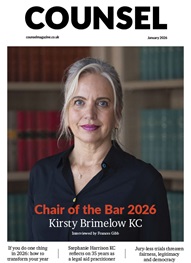

Kirsty Brimelow KC, Chair of the Bar, sets our course for 2026
What meaningful steps can you take in 2026 to advance your legal career? asks Thomas Cowan of St Pauls Chambers
Marie Law, Director of Toxicology at AlphaBiolabs, explains why drugs may appear in test results, despite the donor denying use of them
Asks Louise Crush of Westgate Wealth Management
AlphaBiolabs has donated £500 to The Christie Charity through its Giving Back initiative, helping to support cancer care, treatment and research across Greater Manchester, Cheshire and further afield
Q and A with criminal barrister Nick Murphy, who moved to New Park Court Chambers on the North Eastern Circuit in search of a better work-life balance
The appointments of 96 new King’s Counsel (also known as silk) are announced today
Ready for the new way to do tax returns? David Southern KC continues his series explaining the impact on barristers. In part 2, a worked example shows the specific practicalities of adapting to the new system
Resolution of the criminal justice crisis does not lie in reheating old ideas that have been roundly rejected before, say Ed Vickers KC, Faras Baloch and Katie Bacon
With pupillage application season under way, Laura Wright reflects on her route to ‘tech barrister’ and offers advice for those aiming at a career at the Bar
Jury-less trial proposals threaten fairness, legitimacy and democracy without ending the backlog, writes Professor Cheryl Thomas KC (Hon), the UK’s leading expert on juries, judges and courts